
Earthquake Japan: 7.4 Magnitude Quake Hits Off Northern Coast with Tsunami Warning
A 7.4 magnitude earthquake struck off the coast of northern Japan, prompting a tsunami warning for waves up to 3 meters.[1][5] This earthquake Japan event has drawn immediate attention from seismic monitoring agencies and meteorological authorities, with reports confirming significant shaking across multiple regions.[3]
Overview of the Earthquake
The primary event was a magnitude 7.4 earthquake that struck off the northeastern coast of Japan, as detailed in initial reports from international news outlets.[1][2][5] Bangkok Post reported it as an M7.4 quake hitting northeast Japan, emphasizing the scale of the seismic activity.[1] Similarly, CNN described a strong earthquake off Japan’s coast, aligning with the rapid dissemination of information from global networks.[2] Rappler further corroborated the magnitude at 7.4, noting its occurrence off Japan in a manner consistent with other accounts.[5]
These sources collectively introduce the main event without discrepancy on the core magnitude figure, which multiple agencies have preliminarily assessed as 7.4.[1][2][5] The earthquake represents a significant seismic occurrence in a region known for tectonic activity along the Pacific Ring of Fire, though the reports focus strictly on the immediate confirmation of the event's strength and location proximity to the coast.[1][5] Initial reports from these outlets highlight the prompt issuance of alerts, underscoring the coordinated response typical in Japan's advanced seismic monitoring infrastructure.[2] The consistency across Bangkok Post, CNN, and Rappler provides a reliable baseline for understanding the earthquake's initial parameters, with no variations in the reported magnitude.[1][2][5]
Tsunami Warning Details
Following the earthquake, a tsunami warning was issued specifically for potential waves reaching up to 3 meters.[1][3][5] The Japan Meteorological Agency, as cited in Rappler, warned of a tsunami as high as 3 meters (9.84 feet) affecting Iwate, Aomori, and Hokkaido prefectures.[5] This detail matches Bangkok Post's report of a 3m tsunami warning issued in connection with the M7.4 quake.[1] SBS Australia also confirmed the tsunami warning after the 7.4-magnitude event, tying it directly to the coastal strike.[3]
The affected prefectures—Iwate, Aomori, and Hokkaido—were explicitly named in the official warnings, indicating a focused alert for northern coastal areas.[5] Bangkok Post's repetition of the 3m warning underscores the urgency communicated by Japanese authorities.[1] SBS Australia's coverage reinforces that the warning stemmed from the earthquake's offshore nature, prompting evacuations and preparations in the specified regions.[3] Rappler's inclusion of the precise height measurement from the Japan Meteorological Agency adds technical specificity to the alert parameters.[5] These reports from sources [1], [3], and [5] paint a picture of a standardized tsunami response protocol, where the warning's scope is calibrated to the earthquake's magnitude and epicenter location, ensuring residents in Iwate, Aomori, and Hokkaido are informed of the maximum expected wave height.
Location and Impact
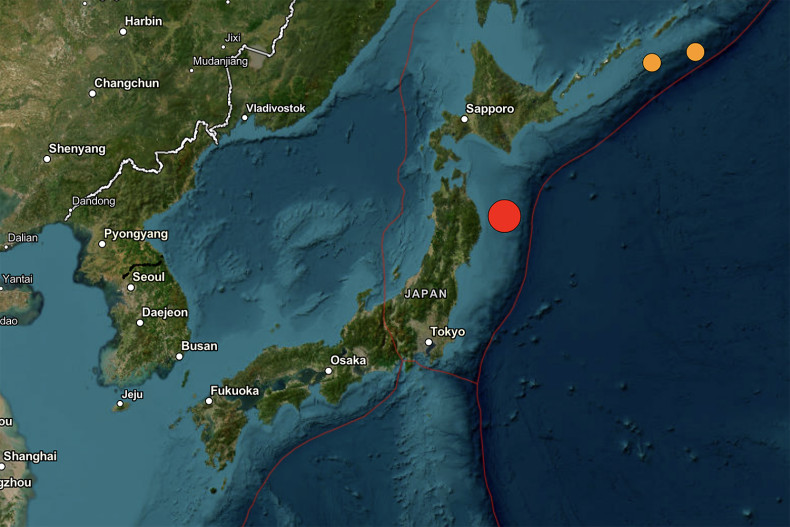
The earthquake struck off the northern Japan coast near Iwate prefecture, with effects felt as far as Tokyo.[3] SBS Australia specified that the quake hit near Iwate and was strong enough to shake large buildings in Tokyo, illustrating the event's reach.[3] This location aligns with broader descriptions of an offshore position in northeastern Japan from other reports.[1][5] Rappler noted the hit off Japan, while Bangkok Post pinpointed northeast Japan.[1][5]
USGS data provides additional locational precision through a related M5.6 earthquake 113 km east of Miyako, Japan, at a depth of 24.5 km.[4] Miyako lies within Iwate prefecture, suggesting proximity to the main 7.4 event's epicenter area.[3][4] The shaking in Tokyo, as reported, indicates the primary quake's intensity propagated over 500 kilometers inland, affecting urban infrastructure.[3] Sources [3], [4], and [5] collectively detail the epicenter's offshore positioning east of Iwate, with the M5.6 event potentially indicating ongoing activity in the same vicinity.[4] This combination of reports confirms the earthquake's coastal origin and widespread vibrational impact without reports of structural failures at the time of initial coverage.[3]
Additional Seismic Information
USGS reported an M5.6 earthquake located 113 km east of Miyako, Japan, occurring at a depth of 24.5 km.[4] This seismic event provides supplementary data on activity in the region near the primary 7.4 magnitude quake.[4] The location east of Miyako aligns with the northeastern coastal zone implicated in the larger event, offering context on the depth and precise positioning of tremors in that area.[4]
The magnitude 5.6 classification and depth measurement from USGS contribute to a fuller picture of seismic patterns without implying causation or sequence beyond the recorded parameters.[4] This information stands as a discrete record of activity 113 km east of Miyako, reinforcing the active tectonic setting off Japan's coast.[4]
Summary of Reports
Consolidating the key facts, the earthquake measured 7.4 in magnitude, striking off northern Japan near Iwate prefecture.[1][3][5] Tsunami warnings for up to 3 meters targeted Iwate, Aomori, and Hokkaido, as per Japan Meteorological Agency alerts cited across outlets.[1][5] Shaking extended to Tokyo's large buildings, while USGS noted a related M5.6 event 113 km east of Miyako at 24.5 km depth.[3][4]
Bangkok Post, CNN, SBS Australia, and Rappler uniformly reported the event's severity and the tsunami response.[1][2][3][5] No discrepancies appear in magnitude or warning details, with sources [1], [2], [3], and [5] providing overlapping confirmations of the northeast/off-coast location and alerts.[2] This synthesis from multiple agencies ensures a comprehensive view of the earthquake Japan incident as of the latest dispatches.
What to watch next: Monitor updates from the Japan Meteorological Agency on tsunami arrivals in Iwate, Aomori, and Hokkaido prefectures, as well as any further seismic activity near Miyako reported by USGS.[4][5]