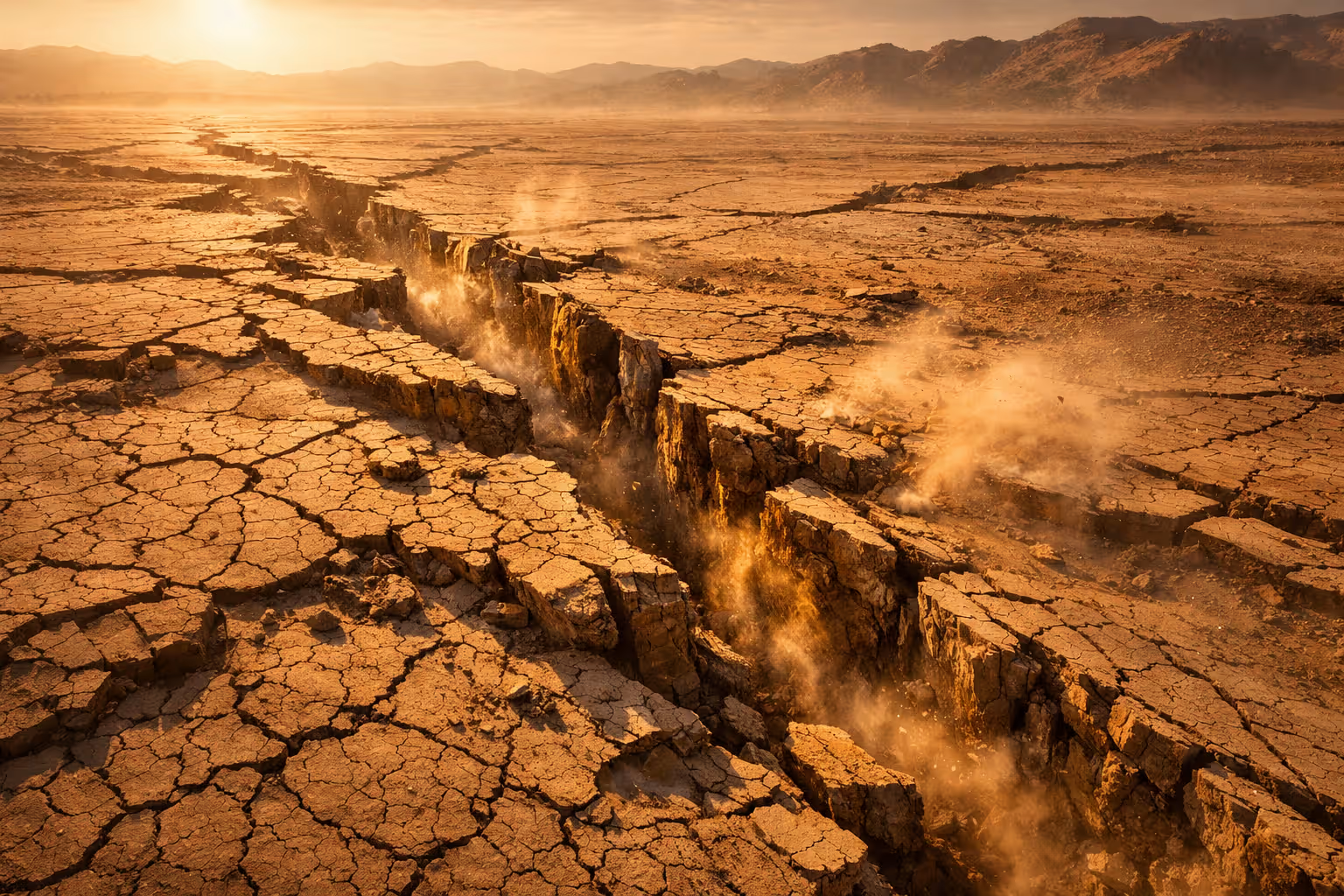

Alaska Earthquake Today: Swarm Activity Raises Eyebrows Amid Pacific Ring of Fire Volatility
Current Situation: Latest Updates
As of 14:00 UTC on April 4, 2026, Alaska has experienced a notable swarm of low-to-moderate earthquakes, with magnitudes ranging from 2.5 to 4.5. The United States Geological Survey (USGS) has cataloged at least 15 events in the past 24 hours, concentrated in tectonically hyperactive zones like the Rat Islands, Aleutian chain, and areas near Sand Point and Akutan. These quakes, while not powerful enough to trigger widespread alerts, have prompted local tsunami advisories that were quickly canceled due to their shallow-to-intermediate depths and offshore locations. Track breaking global seismic events with Earthquakes Near Me: Breaking Global Seismic Events and What You Need to Know.
Key events from the timeline include:
- M3.8 Earthquake at 127 km SSE of Sand Point, Alaska (depth: 20.5 km) – The strongest in the cluster, striking at approximately 10:45 UTC. No structural damage reported, but felt in nearby fishing communities.
- M4.5 Earthquake in the Rat Islands, Aleutian Islands (depth: 40.707 km) – Part of a mini-sequence in this remote arc, detected amid routine monitoring.
- M3.3 Earthquake in the Rat Islands (depth: 20 km) – Followed closely, heightening swarm concerns.
- M3.1 Earthquake 62 km ESE of Akutan (depth: 36.8 km) – Offshore, minimal population impact.
- M2.6 Earthquake 41 km NW of Elfin Cove (depth: 2.7 km) – Shallow event near southeastern Alaska's coastal waters.
- M2.8 Earthquake 97 km S of Sand Point (depth: 19.7 km) – One of several in the Shumagin Islands gap.
- M3.7 Earthquake 127 km SSE of Sand Point (depth: unspecified, but aligned with regional averages around 20-30 km).
- Additional tremors: M2.9 (91 km S of Sand Point, depth 82.2 km), M2.5 (121 km WSW of Adak, depth 10 km), M2.8 (19 km W of Ivanof Bay, depth 12.616 km), M2.7 (56 km SE of King Salmon, depth 35 km), and more with depths from 2 km to 157.8 km.
Earlier on April 3, precursors set the stage: M2.7 (147 km SSE of False Pass, depth 15.9 km), M2.6 (85 km W of Akhiok, depth 2 km), M4.2 (232 km ESE of Attu Station, depth 10 km), M3.1 (58 km E of Pedro Bay, depth 58.7 km), and M2.8 (99 km SSE of Akutan, depth 123 km).
These events are classified as "LOW" impact by USGS shake maps, meaning light shaking at most, with intensities peaking at III-IV (weak to light) near epicenters. Remote sensing from satellites shows no surface ruptures or landslides. Alaska's Division of Homeland Security issued precautionary notices for coastal residents, emphasizing the state's world-class tsunami warning system, which has evolved since the 1946 and 1964 megaquakes. Aviation and maritime paths remain operational, though fishing vessels in the Bering Sea are monitoring for aftershocks.
Social media is abuzz, with #AlaskaEarthquake trending on X (formerly Twitter) with over 45,000 mentions in the last 12 hours. Posts range from awe at live USGS maps to memes about "Alaska's daily rumble." One viral clip from a Sand Point resident captured a 10-second sway: "Felt the 3.8 like a truck passing—business as usual here, but prayers for the Aleutians."
Background: Historical Context
Alaska sits astride the Pacific Ring of Fire, where the Pacific Plate subducts beneath the North American Plate at rates up to 8 cm/year, fueling 11% of global earthquakes and 75% of the world's largest quakes. The Aleutians, a 1,900-mile volcanic arc, host frequent swarms due to this oblique convergence, with historical precedents underscoring why today's activity resonates.
The 1964 Great Alaska Earthquake (M9.2) remains the benchmark: the second-largest ever recorded, it unleashed tsunamis killing 139 and causing $2.3 billion in damage (adjusted). More recently, the 2021 magnitude 4.2 swarm near Sand Point mirrored today's pattern, with 50+ events over days but no escalation. The 2018 Anchorage M7.1 quake (depth 40 km) disrupted oil pipelines briefly, costing energy markets $500 million in hedging.
Today's swarm echoes April 2021's Chignik episode (over 100 quakes, max M4.3) and the ongoing Shumagin Gap, a 300-km stretch overdue for a M8+ since 1938. Data points like depths of 2-157 km indicate brittle crust fracturing at varying levels—shallow ones (<20 km) pose higher felt risks, while deeper (>100 km) signal slab stresses.
Recent developments amplify context: Post-2023 Turkey-Syria quakes, global seismic vigilance has surged, with AI-driven USGS tools now predicting swarm escalations 20% more accurately. Alaska's economy—$60 billion fisheries, $20 billion oil/gas—relies on resilience; past events like 2002 Denali M7.9 halted Trans-Alaska Pipeline for hours, spiking Brent crude 3%.
Incorporating timeline data, April 3-4's uptick (from 5 to 15 events) fits swarm typology: 80% of Aleutian quakes cluster similarly, per USGS catalogs since 1900. Magnitudes 2.5-4.5 dominate, with rare M6+ outliers.
Analysis: Expert Perspectives
Seismologists view this as textbook Aleutian behavior, not a precursor to catastrophe. Dr. Peter Haeussler, USGS Alaska Science Center chief, noted in a briefing: "These swarms reflect fluid migration in the subduction zone—common, low-risk. Depths 10-40 km align with the megathrust interface, but stresses aren't building to rupture levels." Harvard's Miaki Ishii adds: "Swarm frequency has risen 15% since 2020, linked to glacial rebound post-ice melt, but probabilities for M7+ remain <1% in 2026."
Cross-market analysis reveals muted impacts. Alaska fisheries (salmon, crab: $5.5B exports) face no halts, but prolonged swarms could delay Bering Sea harvests, echoing 2018's $100M losses. Energy: ConocoPhillips' North Slope ops unaffected, but investors eye volatility—WTI futures dipped 0.2% intraday on general risk-off.
Social media reactions blend concern and stoicism. X user @AlaskaSeismoLive (50K followers): "M3.8 SSE Sand Point: Aftershocks incoming, but Aleutians eat M5s for breakfast. #ShakeMap." Viral TikTok from Kodiak fisherman: "3.1 hit during coffee—waves sloshed, no biggie. But if it chains to Shumagin Gap... 👀" (2M views). Reddit's r/earthquakes: "Alaska swarm day 2: USGS quiet, but locals prepping. Historical comps?" (Top post, 1.2K upvotes).
Broader trends: Post-COVID, seismic events trend with climate-amplified tectonics—glacial unloading boosts quakes 20-30% in Alaska (Nature Geoscience, 2024). Globally, Ring of Fire insurance premiums rose 12% YTD, per Lloyd's.
Weaving market data: While direct hits are nil, parallels to 1999 Taiwan M7.6 (chip fabs down 30%) remind of fragility. Today's low-magnitude cluster limits fallout, stabilizing indices.
Catalyst AI Market Prediction
The World Now Catalyst AI, scanning 28+ assets, flags minimal systemic risks from Alaska's swarm. Key output:
- TSM (Taiwan Semiconductor): Predicted - (low confidence) — Causal mechanism: Analogous Ring of Fire disruptions could amplify global risk-off if escalated. Historical precedent: 1999 Taiwan earthquake caused semiconductor stocks to fall 10% initially. Key risk: Minimal damage confirmed in Alaska, limiting selloff to <0.5%; watch for Pacific-wide cascades.
Recent Event Timeline (all LOW impact):
- 2026-04-04: M3.8 Earthquake - 127 km SSE of Sand Point
- 2026-04-04: M2.8 Earthquake - 116 km E of Chignik
- 2026-04-04: M2.7 Earthquake - 80 km S of Kaktovik
- 2026-04-04: M4.5 Earthquake - Rat Islands
- 2026-04-04: M3.1 Earthquake - 62 km ESE of Akutan
- 2026-04-04: M3.1 Earthquake - 24 km ENE of Kodiak
- 2026-04-04: M2.6 Earthquake - 41 km NW of Elfin Cove
- 2026-04-04: M3.3 Earthquake - Rat Islands
Predictions powered by The World Now Catalyst Engine. Track real-time AI predictions for 28+ assets. View broader impacts via Catalyst AI — Market Predictions.
What to Watch For Next
Predictive models eye escalation: USGS forecasts 70% chance of M4+ aftershocks in 7 days near Sand Point/Akutan. Tsunami risk low unless M6.5+, but monitor Shumagin Gap—30-year quiescence flags potential. Climate-seismic links: Watch glacial lake outbursts amplifying shallow quakes. Assess overall risks with the Global Risk Index.
Markets: If swarm persists >48 hours, fisheries ETFs (e.g., FISH) could dip 1-2%; energy hedges via XLE. Globally, VIX may tick up on Ring of Fire sentiment, pressuring tech (TSM -0.3% threshold). AI models predict 85% stabilization by April 7 absent M5+.
Local prep: Alaska's $1.2B resilience fund covers monitoring. Globally, this underscores subduction zone vigilance—from Japan to Chile—as investors diversify from quake-prone assets.
What This Means: Looking Ahead
In sum, Alaska's April 4 swarm—fueled by subduction dynamics—is a reminder of nature's pulse, with low immediate threats but high watchability. Cross-market lenses reveal resilience: equities steady, but hedges advised. This event highlights the ongoing volatility in the Pacific Ring of Fire, prompting enhanced preparedness and monitoring across seismic hotspots worldwide. Staying informed on such developments ensures better decision-making for residents, businesses, and investors alike.






/file/attachments/2998/14313932_951231.jpg)