
US Forces Disable Oil Tanker Heading to Iran as Strait of Hormuz Blockade Resumes
The United States has resumed its naval blockade of Iran in the Strait of Hormuz, disabling a non-compliant oil tanker with Hellfire missiles on the first day of renewed enforcement while launching additional strikes on Iranian military targets.
US Disables Tanker on First Day of Renewed Blockade
US Central Command disabled the Curacao-flagged M/T Belma tanker, which ignored warnings while heading to Iran's Kharg Island oil terminal; two other vessels complied and altered course. [3] The commercial vessel ignored multiple warnings as it attempted to violate the US blockade. [3] A US aircraft disabled the vessel after firing Hellfire missiles into the ship's smokestack. [3] The ship is no longer transiting to Iran. [3] During the first 24 hours of enforcement, Centcom has redirected two compliant commercial vessels and disabled one non-compliant vessel. [3] US forces remain vigilant and prepared to ensure full compliance. [3]
Blockade Reinstated After Ceasefire Collapse
The blockade was reimposed on July 14 after the collapse of a fragile US-Iran ceasefire, following an earlier phase that redirected 142 vessels and disabled nine ships. [3] The blockade resumed at 4 pm ET on July 14, with US forces preventing vessels from travelling to or from Iranian ports and coastal areas. [3] This was the first vessel disabled since the naval blockade was reimposed, after Washington resumed the restrictions following the collapse of a fragile ceasefire with Iran. [3] During the previous blockade, which lasted nearly two months before being lifted in mid-June under a temporary US-Iran memorandum of understanding, Centcom said it had redirected 142 commercial vessels and disabled nine non-compliant ships. [3] The US initially imposed the blockade in April before lifting it last month after signing an interim agreement with Tehran that paused hostilities and opened a 60-day window for negotiations on Iran's nuclear programme and regional security. [3] Those talks have since stalled as fighting intensified around the Strait of Hormuz. [3]
Strikes Target Iranian Military Capabilities
US forces conducted strikes targeting Iranian military capabilities used to threaten shipping in the Strait of Hormuz, with explosions reported in Bandar Abbas, Ahvaz and Chabahar. [3] At 3 pm ET today, US Central Command forces began launching an additional round of strikes against Iran. [3] The new strikes focused on Iranian military capabilities used to threaten vessels freely transiting through the Strait of Hormuz. [3] The US military was holding Iran accountable at the Commander in Chief's direction. [3] Explosions were later reported in several parts of southern Iran, including Bandar Abbas, Ahvaz and Chabahar, while Iranian state media said a projectile landed near Shahid Baghaei Hospital in Ahvaz, damaging nearby homes and forcing the temporary evacuation of patients. [3]
Iran Warns of Wider Energy Disruption
Iran has condemned the actions, with its parliament speaker and Islamic Revolutionary Guard Corps warning that energy exports from the region will be available to everyone or to no one. [3] Iranian parliament speaker Mohammad Bagher Qalibaf said Washington was attempting to undermine what he described as Iranian arrangements governing navigation through the Strait of Hormuz. [3] In a separate statement, Iran's Islamic Revolutionary Guard Corps warned that the export of oil and gas from the region will be either for everyone or for no one. [3] Iran has condemned the renewed blockade, warning it could expand the conflict by disrupting energy exports across the region. [3]
Thai Businesses Advised to Monitor Risks
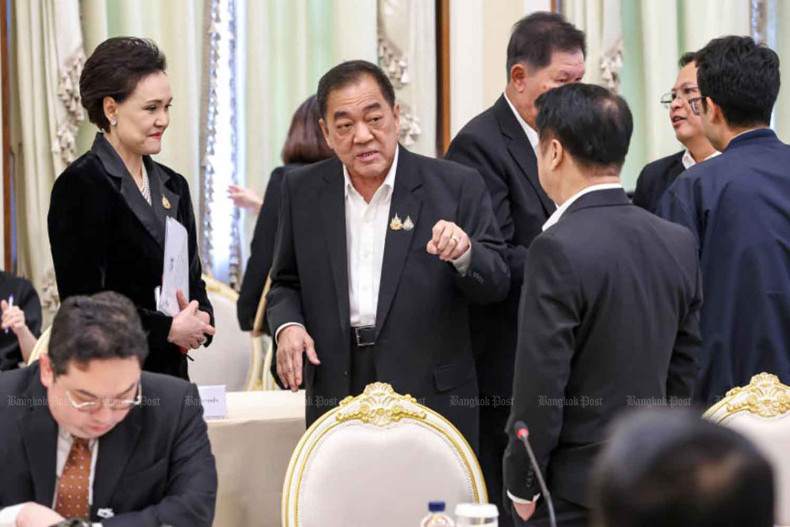
The Thai Chamber of Commerce is urging businesses to monitor the situation, prepare contingency plans, reroute shipments via UAE and Omani ports, and maintain inventories amid risks to freight, insurance, energy prices and raw material supplies. [1] The Thai Chamber of Commerce is urging businesses to monitor developments in the Strait of Hormuz and be prepared to manage potential risks. [1] Poj Aramwattananont, chairman of the chamber, said tensions in the strait are escalating again as the conflict between the US and Iran ratchets up and the ceasefire collapses. [1] The war has the potential to disrupt maritime transport through the Middle East, contributing to volatility in freight and insurance premiums, possibly increasing energy prices, and delaying raw material supplies for the manufacturing sector. [1] He said shipments are being rerouted to Khor Fakkan port in the United Arab Emirates and to the ports of Salalah and Sohar in Oman instead of transiting the Strait of Hormuz. [1] Shipping lines are continuously assessing the risks associated with routes through the Strait of Hormuz, resulting in only a very small number of vessels travelling through the strait. [1] Businesses should not panic, but instead monitor the volatile and unpredictable situation, Mr Poj said. [1] He advised companies to keep a close watch on energy prices, transport costs and logistics expenses, while maintaining adequate inventories of raw materials and finished products to meet demand. [1] Businesses should prepare contingency plans to secure alternative sources of raw materials and goods in case of future shortages. [1] Companies are advised to work closely with shipping lines and logistics service providers to identify the most efficient and cost-effective shipping routes through the Middle East, said Mr Poj. [1] The chamber is ready to coordinate with the government and relevant agencies to help mitigate the impact of the Middle East conflict on Thai companies, he noted. [1]
Related ICC Sanctions Challenged in US Lawsuit
The separate but concurrent US-Iran-Israel tensions reflected in a new lawsuit claiming Trump administration sanctions on the ICC and Palestinian groups violate free speech by suppressing pro-Palestinian advocacy. [2] A lawsuit by two US-based advocacy groups argues the Trump administration is stifling freedom of speech through penalties it imposed last year against the International Criminal Court and Palestinian human rights groups. [2] The groups are challenging an executive order signed by President Donald Trump that placed sanctions on ICC judges, prosecutors and groups that are seeking a ruling against Israel over claims of human rights violations. [2] Representatives of the groups argue Trump's order is being used to illegally police the political expression of millions of Americans and suppress pro-Palestinian advocacy. [2] The sanctions are being used not only to punish human rights defenders but to police the political expression of millions of Americans, said Dawn's executive director Omar Shakir. [2] Trump's executive order issued in February 2025 placed financial and visa restrictions on individuals who assist in ICC investigations of American citizens or US allies, and their families. [2] Washington has said the order would punish ICC judges and Palestinian non-governmental organisations who had called for the court to investigate allegations that Israel has committed war crimes in the Gaza Strip and the occupied West Bank. [2] In the lawsuit filed on Wednesday, the groups said they had not made submissions to the court or co-ordinated advocacy with those hit by the sanctions for fear of potential fines and other reprisals. [2] They argued such limitations were a violation of the US Constitution. [2] The action came after US officials launched a bid to dismantle the ICC, arguing it posed a threat to US sovereignty. [2] Earlier this week, Secretary of State Marco Rubio suggested the US could expand its sanctions, vowing to use all the tools at our government's disposal to dismantle the ICC, brick by brick, if necessary. [2] Rubio claimed the court threatened America's political and legal system. [2] The US and Israel are not members of the ICC, which was established in 2002 with the power to bring prosecutions for alleged genocide, crimes against humanity and war crimes. [2] Trump announced the executive order last year after hosting Israel's Prime Minister Benjamin Netanyahu. [2] The ICC had issued an arrest warrant for Netanyahu in 2024 over alleged war crimes in Gaza. [2]
What to watch next: Businesses should continue to monitor developments in the Strait of Hormuz and prepare contingency plans as tensions remain volatile, while the lawsuit challenging sanctions on the ICC proceeds in US courts.