
UN Human Rights Council Condemns RSF Violence in Sudan's el-Obeid
The United Nations Human Rights Council has condemned escalating violence by Sudan's Rapid Support Forces in and around el-Obeid as the country's war enters its fourth year, with at least 59,000 people killed and 13 million displaced.
UN Resolution Condemns RSF Violence in Sudan
The top United Nations human rights body approved without a vote a measure that condemns the escalating violence by Sudan's paramilitary Rapid Support Forces and its allies in and around the city of el-Obeid in the North Kordofan region. [5] The resolution was brought by Britain, Germany, Ireland, the Netherlands and Norway at the Human Rights Council. [5] It also encourages greater support for countries hosting refugees from Sudan and condemns all forms of external interference in the war. [5] China, Cuba, Egypt and Pakistan dissociated themselves from any consensus on the measure, with some expressing concerns about references to a fact-finding mission that the council has already set up to focus on rights abuses in Sudan's war. [5] On Friday, U.N. human rights chief Volker Türk sounded a red alert about possible atrocity crimes in and near el-Obeid, a strategic city in central Sudan, and called on world leaders to do more to help stop the bloodshed in the country’s ongoing war. [5] His comments came as the council held an urgent debate on the situation in el-Obeid about concerns expressed by diplomats, advocacy groups and others that another wave of atrocities may loom against civilians in Sudan’s war. [5]
Humanitarian Toll of Sudan's War
The war erupted in April 2023 out of long-simmering tensions between the army and RSF. [5] The conflict has killed at least 59,000 people, displaced some 13 million and pushed many parts of Sudan into famine. [5] More than 30 million people are in need of humanitarian assistance. [5] The resolution encourages greater support for countries hosting refugees from Sudan while condemning all forms of external interference in the war. [5] Volker Türk issued the red alert over possible atrocity crimes in and near el-Obeid as the council addressed fears of further civilian harm amid the fourth year of fighting. [5] The measure was adopted without a vote after an urgent debate triggered by reports of mounting violence around the strategic city. [5]

UN Human Rights Council resolution condemns RSF violence in Sudan's el-Obeid. — Source: reliefweb
Nigeria Senate Highlights Attacks on Military Personnel
The Senate on Tuesday expressed grave concern over the country’s worsening security situation, warning that the abduction and killing of retired military officers by terrorists and criminal gangs represents a dangerous escalation of Nigeria’s security crisis. [1] The Red Chamber said the growing pattern of attacks on serving and retired military personnel poses a serious threat to national stability, public confidence and the country’s security architecture. [1] The concern followed a motion moved by Senator Abdulaziz Yar’Adua during plenary over the death of retired Major General Alkali Abubakar, a former Director of Defence Information, who was abducted alongside his wife in Katsina State on May 30, 2026, and later died in captivity. [1] Adopting the motion, senators observed a minute’s silence in honour of the late military officer and resolved to convey their condolences to his family and the Nigerian Armed Forces. [1] The Senate described the late general’s death as more than a personal tragedy, saying it reflected the growing threat posed by insecurity across the country. [1] According to the lawmakers, the death of retired Major General Alkali Abubakar and others in the custody of terrorists represents not only personal tragedies but also a painful national loss and a stark reminder of the scale and persistence of insecurity confronting the nation. [1] The Senate also highlighted what it described as a disturbing pattern of attacks targeting serving and retired military personnel. [1] Lawmakers cited several incidents recorded between January 2023 and May 2026, including the killing of retired Major General Richard Duru in Owerri after a reported ransom payment of $50,000, the murder of retired Brigadier General O.M. Harlord Udokwere in Abuja, the 56-day captivity of former National Youth Service Corps Director-General, retired Brigadier General Maharazu Tsiga, and the death in captivity of retired Major Aja in Kogi State. [1] The Senate warned that the increasing frequency of such attacks marks a troubling shift in the country’s security challenges. [1] In its resolution, the Senate stated that the increasing frequency with which serving and retired military personnel are being targeted by criminal and terrorist groups represents a dangerous evolution in the nation’s security challenges. [1] It added that many of the victims previously occupied sensitive intelligence, operational and command positions, making the attacks a matter of national security rather than isolated criminal incidents. [1] The upper chamber stressed that the insecurity now extends beyond individual victims and has far-reaching implications for national unity, democratic stability and public confidence in government. [1] The Senate noted that the constitutional responsibility of government to protect lives and property remains fundamental to national unity, democratic stability, economic growth and public trust in governance. [1] While commending the Armed Forces, the Nigeria Police Force, the Department of State Services, the Nigeria Security and Civil Defence Corps and other security agencies for their sacrifices in combating insecurity, lawmakers called for urgent improvements in intelligence gathering, inter-agency collaboration, the deployment of technology and stronger community engagement to prevent future attacks. [1] The Senate further observed that the persistent wave of kidnappings and killings across the country has resulted in deaths, prolonged captivity, ransom payments, emotional trauma, economic hardship and psychological distress for victims, their families and the nation, underscoring the urgent need for a more coordinated and effective national security response. [1]
Deadly Police Operation in Ghana
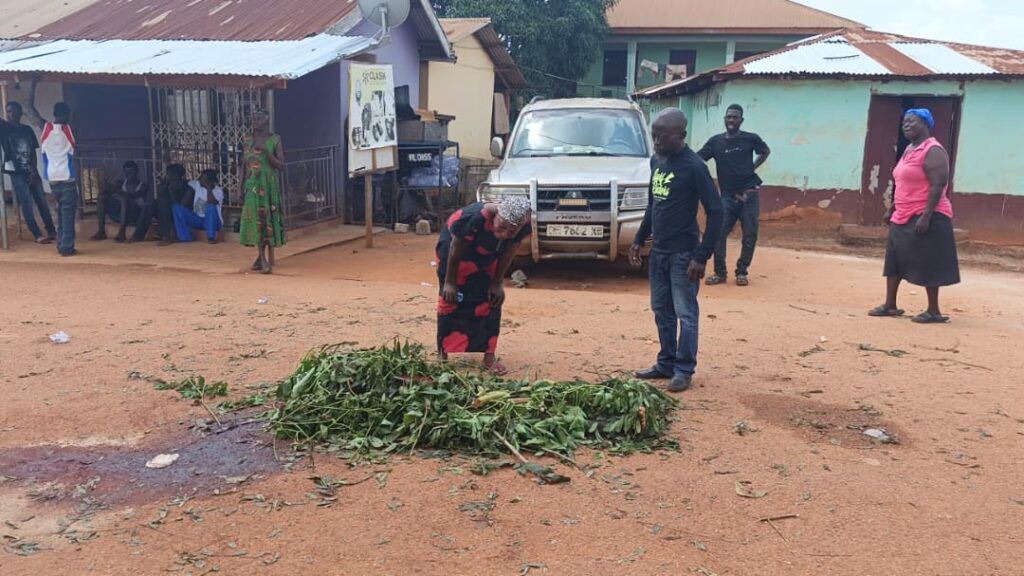
Two people have reportedly been killed, and two others sustained gunshot injuries following a confrontation between police officers and residents at Sefwi Sayerano in the Western North Region. [2] The incident is alleged to have occurred when officers from the Sefwi Wiawso Divisional Police Command went to the community to arrest a suspected drug peddler. [2] Speaking to Adom News, Okyeame Kwaku Ortiz said some residents attempted to resist the arrest, leading to a confrontation during which the police allegedly opened fire. [2] Two people were confirmed dead at the scene, while two others sustained gunshot injuries and fractures. [2] Another person is reportedly missing, with residents expressing fears that the individual may also have been shot. [2] The injured victims have been taken to a health facility for treatment, while one of the bodies of the deceased has been deposited at the mortuary, with the other still in the town. [2] Okyeame Kwaku Ortiz expressed disappointment in the police over the handling of the operation and called on authorities to ensure justice is served. [2] Meanwhile, the police are yet to issue an official statement on the incident as investigations continue. [2]
West Bank Workers Risk Lives for Employment in Israel
In April, around 70 Palestinian men climbed into the back of a rubbish truck, hoping to cross into Israel undetected and search for work. [4] Quickly discovered at a West Bank checkpoint, the men were left to languish under trash bags for over two hours in sweltering heat, before being pulled out and detained by Israeli soldiers. [4] Majd, a 37-year-old from Beit Furik, just south of Nablus, was one of the labourers crammed inside. [4] He asked that his real name not be used. [4] At the beginning when they stopped us, we were afraid to go to jail. Then when it took longer to get out, we were scared to die. [4] In the immediate aftermath of 7 October 2023, Israel cancelled around 150,000 work permits. [4] As savings have dried up, many Palestinians have had no choice but to sneak into Israel. [4] Permit revocations are only one of the drivers behind the West Bank's economic crisis, which has seen GDP contract by more than 20 percent. [4] A fifth of the West Bank's labour force crossed into Israel for work before the war. [4] Clearance revenue accounted for about 70 percent of the PA's total income. [4] Immediately after the attack, the Israeli government pulled both levers, revoking all permits and withholding funds. [4] The private sector is suffering and cannot sell their product because the purchasing power of the family is now very low. [4] Majd had spent six years working in construction around Tel Aviv, earning between 7,000 and 8,000 shekels a month. [4] Through the first year of closures, those savings kept his family afloat. [4] As the money ran out, the father of two twice jumped a wall near Jerusalem, staying in Israel for several weeks at a time to work illegally. [4] I looked for jobs here, and I couldn't find anything. When there is a pressure on you to provide, you have to think of a way. [4] Crossing without a permit was common before the war, with an estimated 50,000 Palestinians working without one, but it has become far more dangerous. [4] Alongside the arrests, around 50 men have been killed. [4] Israel's national security minister, Itamar Ben Gvir, said the shooting of labourers was starting to bring the numbers down. [4] For his third crossing, Majd chose the truck after being told it would be safer. [4] No one sees you, so at least you don't get shot. [4] Those without prior convictions, including him, were released the next day and made to walk home past settlements in the early morning. [4] Israel has restored about 7,000 permits in industries it deems critical, but the vast majority of Palestinians remain unable to work. [4] There's no country that has 15 percent unemployment. In Palestine, we're now talking about 30 percent. [4] Such widespread joblessness has helped push the poverty rate to more than double its pre-war level, from 12 percent to 28 percent. [4] Today, Majd gets by on what little his father can spare, unsure whether he will risk the journey again. [4] His children weigh most heavily on him. What's going to happen to them in the future? I am worried I am not able to provide what they need. [4] His father walked by with a small herd of sheep, now the only source of income for a once financially comfortable family. [4] I am depressed from everything that happened. I have become like a dead body. [4]
Ongoing Humanitarian Crisis in the Sahel
Burkina Faso, Mali and Western Niger face a humanitarian overview for 2026 as of 29 June 2026. [3] The overview covers the three countries amid regional instability. [3]
What to watch next: The UN Human Rights Council measure on Sudan and the June 2026 humanitarian overview for Burkina Faso, Mali and western Niger remain key markers as the situations evolve.