Ukraine Strike Targets Russian Tuapse Refinery, Sparking Fire and Evacuations
A Ukrainian drone strike targeted Russia's Tuapse oil refinery, causing a major fire and triggering evacuations in the Black Sea port city.[1] This strike by Ukraine represents the third such attack on the facility in less than two weeks, according to Ukrainian military sources.[1] The Tuapse refinery, operated by Rosneft and vital for Russia's fuel exports, had already suspended operations following a prior drone strike.[2] Ukraine's General Staff has confirmed the operation as part of broader efforts to disrupt Moscow's military and economic potential.[4] In a related action, Ukrainian forces struck a Russian Kasta radar system in Belgorod Oblast, roughly 80 km from the Ukrainian border.[5] Russian authorities have initiated evacuations around the refinery site in response to the blaze.[1][2]
Overview of the Main Strike
The primary event unfolded with a Ukrainian drone strike on the Tuapse oil refinery, a critical infrastructure site in Russia's Krasnodar Krai region along the Black Sea coast.[1][4] This attack, which occurred on the night of April 27-28, ignited a significant fire at the facility, prompting immediate safety measures including evacuations in the surrounding port city.[1][2] Ukrainian officials described the operation as a deliberate move within their ongoing campaign to weaken Russia's logistical backbone, specifically targeting assets that support fuel supplies essential for military endeavors.[4]
Details from reports indicate that the strike Ukraine executed was not an isolated incident but part of a pattern of precision drone operations deep into Russian territory.[1] The Tuapse refinery's role as a major Rosneft installation underscores its strategic value; it processes crude oil into fuels that are exported widely, including to markets that indirectly bolster Russia's war economy.[2] The fire's outbreak following the drone impact led to visible flames and smoke, as captured in videos circulating from the scene, highlighting the strike's immediate disruptive effect.[2] Ukrainian military confirmation came swiftly, with the General Staff publicly acknowledging the hit as a success in their attrition strategy against Russian capabilities.[4]
This overview captures the essence of the strike's execution and its ripple effects: a targeted drone assault resulting in a blaze that necessitated evacuations and raised alarms about the refinery's operational continuity.[1][3] The event fits into Ukraine's broader tactical approach of using unmanned aerial vehicles to reach high-value targets far from the front lines, exploiting vulnerabilities in Russia's defensive perimeter.[4] Reports from multiple outlets emphasize the refinery's repeated exposure, signaling escalating pressure on this key node in Russia's energy infrastructure.[1][2] The Black Sea port city's involvement adds a layer of civilian safety concerns, as authorities scrambled to manage the fallout from the conflagration.[1]
Details of the Incident
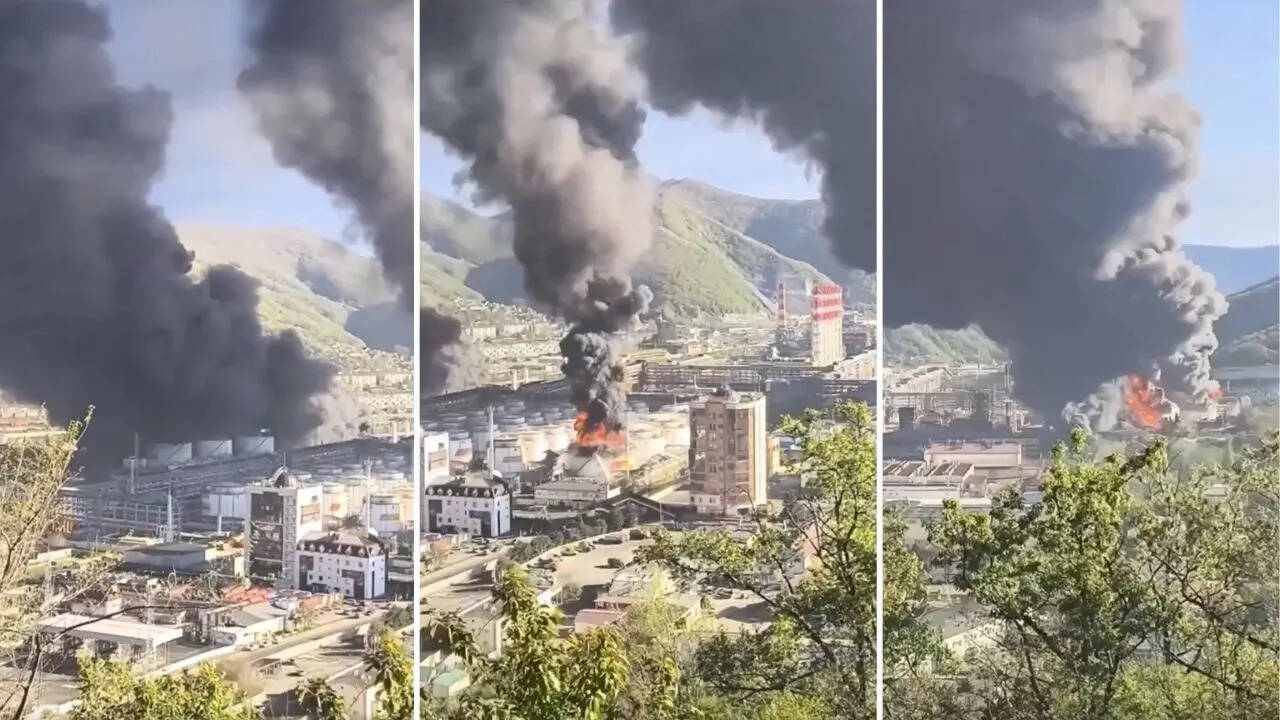
Fire erupts at Russian Tuapse refinery after Ukrainian drone strike, prompting evacuations. — Source: timesofindia
The drone strike by Ukraine directly caused a massive fire at the Tuapse oil refinery, with flames erupting across parts of the facility and leading to the evacuation of nearby buildings.[1][2] Eyewitness accounts and video footage showed thick smoke billowing from the site, underscoring the intensity of the blaze triggered by the Ukrainian operation.[2] Russian authorities responded promptly by ordering residents and workers in adjacent structures to evacuate, prioritizing public safety amid the ongoing emergency.[1][2]
The refinery, a cornerstone of Rosneft's operations, was already in a vulnerable state having halted production after an earlier drone attack, which made this latest strike particularly damaging.[2] The fire's scale necessitated a coordinated response from local emergency services, though specific details on containment efforts remain tied to official statements confirming active measures.[2] The incident unfolded in the port city of Tuapse, where the refinery's proximity to residential and commercial areas amplified the evacuation's scope.[1] Ukrainian sources noted the strike's precision, aimed at disrupting the facility's functionality without broader collateral beyond the immediate site.[4]
Further elaboration from reports paints a picture of chaos at the scene: the drone's impact likely targeted processing units or storage areas, given the refinery's history of similar vulnerabilities.[2] Evacuations were mandated for buildings in close proximity, reflecting concerns over potential secondary explosions or toxic releases from the burning oil infrastructure.[1] As of the latest updates, the fire continued to burn, with Russian responders focused on suppression and assessment of structural damage.[2] This level of detail highlights the strike's tangible consequences, from the visual spectacle of the inferno to the logistical challenges of managing evacuations in a busy Black Sea hub.[1][2]
Context and Previous Attacks
The strike on the Tuapse refinery marks the third in less than two weeks, a series Ukrainian defense forces have dubbed a "hat trick," confirming their repeated success against this high-priority target.[1][4] Each assault has exploited the facility's exposed position, building on prior disruptions that forced operational halts.[2] The refinery's strategic importance lies in its capacity to refine and export fuels, providing Russia with essential resources for its military logistics and broader economy.[2][4]
Previous attacks had already compelled Rosneft to suspend activities at Tuapse, demonstrating the cumulative impact of Ukraine's drone campaign on Russian energy production.[2] Ukrainian military sources emphasize that these operations are calibrated to erode Moscow's ability to sustain prolonged conflict, with the refinery serving as a linchpin in fuel distribution networks.[4] The interval between strikes—less than two weeks—indicates a sustained tempo, allowing minimal recovery time for repairs or heightened defenses.[1]
This context reveals a pattern: the first strike halted operations, the second deepened the damage, and this latest one reignited vulnerabilities with a major fire.[1][2][4] Tuapse's location in Krasnodar Krai, overlooking the Black Sea, positions it as a reachable yet symbolically significant target, far from frontline intensity but central to rear-area support.[1][4] Reports frame these as deliberate escalations, with Ukraine's General Staff openly linking them to efforts against Russia's military-economic apparatus.[4] The repeated targeting underscores the refinery's irreplaceable role, as alternative facilities may not fully compensate for its output in export markets.[2]
Related Military Actions
{IMAGE_3}
In tandem with the Tuapse refinery strike, Ukrainian forces executed a separate drone attack on a Russian Kasta-2E radar system located in Belgorod Oblast, approximately 80 km from Ukraine's state border.[5] This operation was carried out by fighters from the Achilles unit of Ukraine's 429th Brigade, showcasing specialized capabilities in striking air defense assets deep within Russian territory.[5]
The Kasta radar, a key component of Russia's surveillance network, was hit precisely by a drone, disrupting its monitoring functions over a wide area.[5] Belgorod Oblast's proximity to the border—though 80 km inland—makes it a frequent target for Ukrainian incursions aimed at neutralizing early-warning systems that protect Russian airspace.[5] This strike complements the refinery attack by diversifying pressure points, from economic infrastructure to military detection hardware.[5]
Details from Ukrainian reports highlight the tactical execution: the Achilles unit's drone navigated to the radar site, delivering a direct impact that likely impaired or destroyed the system.[5] Such actions degrade Russia's ability to track incoming threats, potentially opening corridors for future operations.[5] The 80 km distance exemplifies Ukraine's growing reach with loitering munitions and reconnaissance drones, extending beyond immediate border zones.[5]
Official Responses and Measures
Ukraine's General Staff issued a formal confirmation of the Tuapse refinery strike, framing it as a successful component of their strategy to undermine Russia's military and economic foundations.[4] This acknowledgment aligns with prior statements on the "hat trick" of attacks, signaling confidence in the operations' efficacy.[4]
On the Russian side, authorities mobilized rapidly to the Tuapse incident, ordering evacuations for nearby buildings and implementing response protocols.[1][2] The Kremlin has verified that measures are underway to address the fire and secure the area, with emergency teams deployed to the scene.[2] Local officials in the Black Sea port city coordinated the evacuations, ensuring compliance to mitigate risks from the blaze.[1]
These responses reflect the bilateral narratives: Ukraine touts disruptive successes, while Russia focuses on containment and recovery.[2][4] Ukrainian sources provide operational validation, whereas Russian updates emphasize ongoing management without conceding strategic losses.[1][2]
What to Watch Next
Monitor Russian authorities' progress in extinguishing the Tuapse refinery fire and restoring operations, as well as any escalatory measures announced by the Kremlin in response to the confirmed Ukrainian strikes.[2] Further Ukrainian General Staff updates on additional targets, including radar systems like the one in Belgorod, could indicate sustained campaign momentum.[4][5]