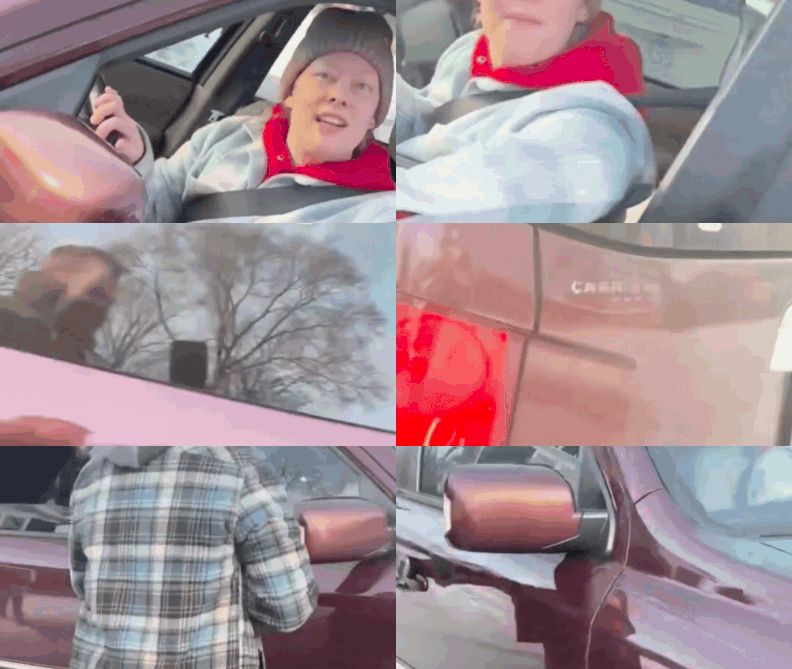

New Video Emerges in Fatal ICE Shooting in Minneapolis, Capturing Victim's Final Words as Investigation Continues
Minneapolis, MN – A newly released video from a fatal shooting involving U.S. Immigration and Customs Enforcement (ICE) agents in Minneapolis has provided a stark perspective from the agent's viewpoint, capturing the last words of victim Renee Good: "Not mad at you." The incident, which unfolded on January 7, 2026, has drawn national attention, with Minnesota Governor Tim Walz calling for calm as federal and local authorities investigate.
The shooting occurred around 5:14 p.m. GMT (11:14 a.m. local time) in Minneapolis, prompting an immediate response from law enforcement and political leaders. According to details emerging from the video footage, highlighted in a report by the Times of India, the recording offers insight into the moments leading up to the confrontation. Renee Good, the individual at the center of the incident, is heard expressing no anger toward the ICE agent in her final moments, a detail that has intensified public scrutiny over the circumstances of the event.
Governor Tim Walz addressed the situation shortly after, urging residents to remain calm while emphasizing that officials are conducting a thorough investigation. "We need to let the facts come out," Walz stated, according to reports from the scene, as tensions simmer in a city with a history of high-profile police interactions. The governor's plea for restraint underscores the volatile atmosphere surrounding immigration enforcement actions in urban centers like Minneapolis.
Details from the Agent's Perspective Video
The video, which surfaced publicly on January 10, 2026, is described as body camera or similar footage from the ICE agent's perspective. It reveals the sequence of events during the encounter with Good, culminating in the shooting. Key elements include Good's audible last words, "Not mad at you," spoken directly to the agent, providing a humanizing glimpse into what witnesses and investigators describe as a rapidly escalating situation.
While full details of the lead-up remain under review, the release of this footage has sparked debates over use-of-force protocols within ICE operations. Federal authorities have not yet issued an official statement on the video's authenticity or its implications, but it aligns with standard body-worn camera practices mandated for many law enforcement agencies since the early 2010s.
Local Minneapolis police and the Hennepin County Sheriff's Office assisted ICE at the scene, securing the area and transporting Good to a nearby hospital, where she was pronounced dead. No injuries to agents or bystanders were reported, and the incident has been classified as high-severity by tracking platforms monitoring real-time events.
Background on ICE Operations and Minneapolis Context
ICE, a component of the U.S. Department of Homeland Security, is responsible for immigration enforcement, including detentions and deportations. The agency has faced increased scrutiny in recent years amid debates over immigration policy, particularly in sanctuary cities like Minneapolis. Minnesota has seen periodic ICE raids and arrests, often leading to protests and legal challenges.
Minneapolis itself has a fraught history with law enforcement interactions, most notably the 2020 killing of George Floyd, which ignited nationwide protests against police brutality. That event led to reforms in local policing, including bans on chokeholds and expanded body camera requirements. While this incident involves federal ICE agents rather than city police, it occurs against this backdrop of heightened sensitivity to use-of-force incidents.
Governor Walz, a Democrat serving since 2019, has navigated tensions between state policies limiting cooperation with ICE and federal mandates. In 2023, Minnesota passed legislation restricting local law enforcement from honoring ICE detainers in certain cases, reflecting broader progressive stances on immigration. Walz's call for calm mirrors his approach during past crises, aiming to prevent escalation while demanding transparency.
Federal investigations into ICE shootings typically involve the Department of Justice's Office of Inspector General and the FBI's Civil Rights Division. Past cases, such as the 2018 fatal shooting of a pedestrian during an ICE operation in Tennessee, have resulted in policy reviews but rarely criminal charges against agents, provided actions align with training guidelines.
Ongoing Investigation and Public Response
As of January 10, 2026, the investigation remains active, with ICE confirming an internal review alongside external probes. Community leaders in Minneapolis, home to diverse immigrant populations from Somalia, Mexico, and Southeast Asia, have organized vigils for Good, whose background details have not yet been fully disclosed pending family notification.
The video's release has amplified calls from advocacy groups like the ACLU for independent oversight of ICE body cameras. "Transparency is the first step toward accountability," said an ACLU spokesperson in a related statement, though specifics on this case were withheld.
No arrests have been made, and ICE has reiterated that agents followed protocol during what they describe as a "dynamic enforcement action." Governor Walz has pledged state resources to support the federal inquiry, including forensic analysis.
Outlook Amid National Tensions
This shooting adds to a string of high-profile law enforcement incidents in the U.S., occurring as immigration remains a flashpoint in national discourse. With the 2026 dates marking early-year enforcement activities, observers anticipate further details from autopsy reports, witness statements, and full video analysis in the coming weeks.
The Minneapolis community braces for potential unrest, but Walz's message of restraint appears to have held for now. As investigations proceed, the nation watches closely, weighing individual rights against the demands of border security in an era of polarized politics.
(Word count: 728)






