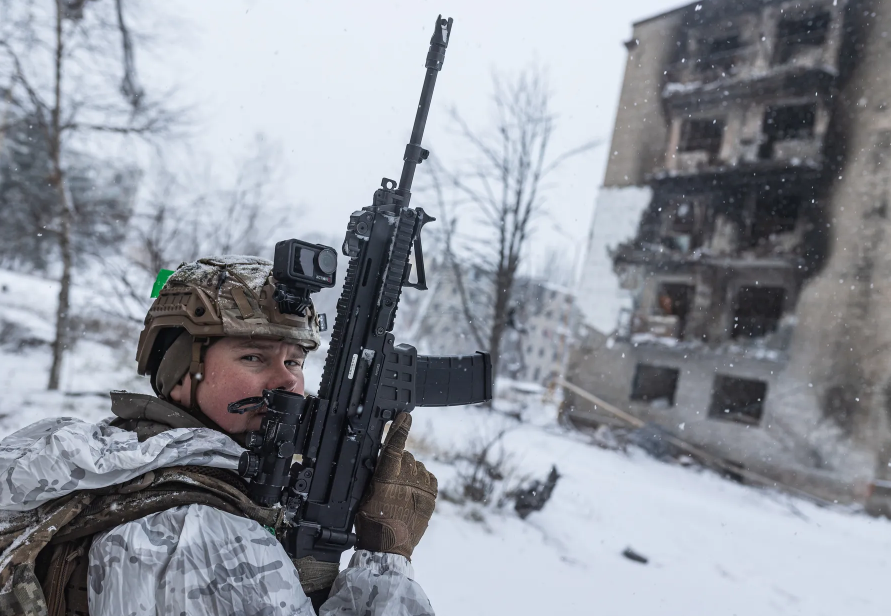

Manpower Emerges as Decisive Factor in Ukraine Conflict's 2026 Trajectory
Kyiv, Ukraine – As the Russia-Ukraine war enters its fourth calendar year, analysts are increasingly focusing on human resources as the pivotal element that could shape the conflict's dynamics throughout 2026. A recent analysis highlights that troop availability, recruitment challenges, and demographic pressures will likely overshadow technological or material advantages, potentially tipping the balance for either side.
The assessment, published on January 7, 2026, by Vietnam News Agency (baotintuc.vn), underscores a shift in the war's strategic calculus. With frontline stalemates persisting despite advanced weaponry like drones and long-range missiles, the sustainability of personnel commitments has become critical. Ukraine, facing acute manpower shortages amid heavy casualties and population outflows, must navigate stringent mobilization laws, while Russia leverages its larger population base and coercive recruitment tactics.
Current Manpower Strains on Both Sides
Throughout 2025, both belligerents grappled with recruitment hurdles that have carried into the new year. Ukraine lowered its conscription age to 25 in April 2024 and expanded mobilization efforts, yet reports from the Institute for the Study of War (ISW) indicate ongoing difficulties in replenishing units depleted by attrition. Casualty estimates, corroborated by Western intelligence, place Ukrainian losses at over 400,000 killed or wounded since February 2022, straining a pre-war active-duty force of around 200,000.
Russia, conversely, has mobilized over 500,000 troops since the full-scale invasion, drawing from prisons, migrants, and regions like North Korea for auxiliary forces. President Vladimir Putin's June 2024 decree authorizing "unscheduled" call-ups allowed for 150,000 additional contract soldiers monthly, bolstering numbers but raising questions about morale and training quality. Demographic data from Rosstat reveals Russia's working-age population declining by 2 million since 2022, complicating long-term sustainability.
The baotintuc.vn article posits that 2026 will hinge on these human factors. It argues that while Western aid has provided Ukraine with superior artillery and air defenses—evident in the repulsion of Russian advances near Kharkiv and Donetsk—sustained infantry is essential for any territorial gains. Russia's strategy of attritional warfare, grinding down Ukrainian defenses through mass assaults, amplifies this vulnerability.
Strategic Implications and Expert Views
Military experts echoed these concerns in late 2025 forums. Michael Kofman of the Center for Naval Analyses noted in a December 2025 Carnegie Endowment briefing that "manpower is the binding constraint," predicting intensified recruitment drives on both sides. Ukrainian Commander-in-Chief Oleksandr Syrskyi acknowledged in a November 2025 interview with The Economist that rotations and reinforcements remain "the key challenge," amid public protests over draft evasion.
Russia's advantages are numerical but not absolute. The U.S. Department of Defense's 2025 posture statement estimated Russian forces at 620,000 in Ukraine and occupied territories, compared to Ukraine's 900,000 total personnel (including reserves). However, Russia's reliance on poorly trained "meat grinder" assaults—as seen in the failed 2024 Avdiivka push—has led to disproportionate losses, with British Ministry of Defence assessments citing up to 1,000 daily casualties at peak.
For Ukraine, international support mitigates some gaps. NATO training programs have graduated over 100,000 troops since 2022, and U.S. aid packages totaling $61 billion through 2025 emphasize infantry equipment like small arms and vehicles. Yet, European allies like Germany and the UK have flagged their own munitions stockpiles, indirectly pressuring manpower efficiency.
Historical Context of the Conflict
The war, ignited by Russia's full-scale invasion on February 24, 2022, followed eight years of hybrid conflict in Donbas. Initial Russian gains—capturing 20% of Ukraine by March 2022—were reversed by Ukrainian counteroffensives, reclaiming Kherson and Kharkiv regions. The 2023 summer counteroffensive stalled against fortified Russian lines, shifting focus to defense and long-range strikes on Crimea and Russian logistics.
Demographics have long favored Russia, with a 2022 population of 144 million versus Ukraine's 41 million (pre-war). Emigration has reduced Ukraine's pool by an estimated 6.5 million, per UNHCR data, while Russia's internal migration from Central Asia provides fillers. These trends, the analysis suggests, will culminate in 2026, potentially forcing negotiated pauses if mobilization falters.
Outlook for 2026
Looking ahead, 2026 could see intensified battles around Pokrovsk and Kurakhove, where Russian forces hold marginal gains. Ukraine's planned F-16 deployments and domestic drone production may offset numbers, but sustained offensives demand fresh troops. Diplomatic efforts, including Switzerland's June 2024 peace summit (boycotted by Russia), remain stalled, with U.S. President-elect dynamics post-2024 elections adding uncertainty.
Neither side shows appetite for capitulation, but manpower limits could precipitate de-escalation. As the baotintuc.vn piece concludes, "human resources will decide the overall situation," urging both Kyiv and Moscow to recalibrate strategies amid global scrutiny.
This evolving dynamic underscores the war's human cost: over 10,000 civilian deaths verified by the UN, millions displaced, and economies strained—Ukraine's GDP contracted 29% in 2022 before partial recovery.
(Word count: 712)






