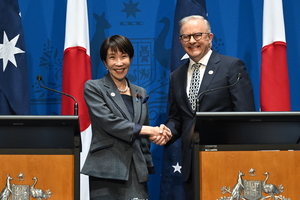

Global Geopolitics Features Japan-Australia Pact on Energy and Defense
In the landscape of global geopolitics, Japan and Australia have agreed to deepen cooperation in energy security, defense, and critical minerals amid threats to global supply chains from the Iran war.[1] This pact underscores efforts by key allies to navigate escalating tensions, as highlighted by recent high-level meetings and reports of disruptions in other regions.
Recent Alliance Developments
The agreement between Japan and Australia marks a significant step in bolstering bilateral ties amid a complex international environment. Japanese Prime Minister Sanae Takaichi met Australian Prime Minister Anthony Albanese in Melbourne, specifically at Australia’s Parliament House, during Takaichi’s first visit to the country as national leader.[1] This encounter on Monday facilitated discussions on strategic issues, including China and Southeast Asia.[1] The focus on deepening cooperation spans energy security, defense, and critical minerals, directly responding to disruptions in global supply chains caused by the Iran war.[1]
Such developments reflect a broader pattern where nations are prioritizing resilient partnerships to safeguard essential resources. Energy security, in particular, has gained urgency as supply chains face vulnerabilities from ongoing conflicts. Critical minerals, vital for technologies ranging from renewable energy to defense systems, are similarly at risk, prompting this enhanced collaboration.[1] The meeting's location in Melbourne and its timing during Takaichi's inaugural trip as leader emphasize the immediacy and importance of these talks.[1] By addressing these areas, Japan and Australia aim to create more stable frameworks for resource sharing and mutual defense, setting a model for alliance-building in the Indo-Pacific region.[1]
Shifts in Global Security Frameworks
Some U.S. allies are seeking to build a new global order in Europe, viewing the existing system of security and trade as broken.[2] Nations aligned with the United States have issued warnings that the framework championed by Western powers for over 70 years is beyond repair.[2] This perspective signals a profound reassessment of international structures established post-World War II, which have underpinned global security and economic interactions.
The push toward a post-Trump global order in Europe highlights dissatisfaction with current mechanisms.[2] Trade systems, once reliable pillars of prosperity, are now seen as inadequate against contemporary challenges. Security architectures, designed during the Cold War era, face criticism for failing to adapt to new threats.[2] Efforts by these allies focus on Europe as a potential hub for reconstruction, aiming to forge alternatives that better address fractures in the international system.[2] This movement underscores a collective recognition that longstanding Western-led initiatives no longer suffice, prompting innovative approaches to multilateralism.[2]
Ongoing Regional Tensions
A Gaza-bound humanitarian flotilla has reported attempts by Israeli forces to intercept it using drones, a military helicopter, and unidentified vessels off the coast of Greece.[3] The Global Sumud Flotilla detailed these approaches in the Mediterranean, raising concerns over the safety of aid efforts directed toward Gaza.[3] Such incidents illustrate the heightened risks faced by humanitarian missions in contested waters.
The flotilla's reports specify the use of drones for surveillance or potential disruption, alongside a military helicopter and vessels that remain unidentified.[3] Occurring off the Greek coast, these events add to the layers of tension in the eastern Mediterranean, where maritime routes are increasingly militarized.[3] The interception attempts come amid broader conflicts involving Gaza, complicating delivery of aid and drawing international attention to freedom of navigation issues.[3] This development highlights the challenges humanitarian groups encounter when operating in regions marked by geopolitical friction.[3]
Interconnected Geopolitical Events
Across regions, these events reveal interconnected threads in global geopolitics, linking Indo-Pacific alliances to European security shifts and Mediterranean tensions. The Japan-Australia cooperation on energy security, defense, and critical minerals directly ties to supply chain threats from the Iran war, influencing strategic discussions on China and Southeast Asia.[1] This mirrors U.S. allies' moves in Europe to overhaul a broken security and trade system after more than 70 years.[2]
Simultaneously, the flotilla interception off Greece— involving drones, a helicopter, and unidentified vessels—exemplifies how regional flashpoints exacerbate global uncertainties.[3] The Iran war's ripple effects on supply chains parallel disruptions in humanitarian corridors, while alliance-building in Melbourne addresses the same systemic failures noted in Europe.[1][2] Japan and Australia's focus on critical minerals and energy underscores vulnerabilities that allies worldwide are confronting.[1] These dynamics show how threats in one area, such as the Middle East, compel responses in the Asia-Pacific and Europe, fostering a web of adaptive strategies.[1][2][3] The strategic talks on China and Southeast Asia further connect to the broader quest for a new global order.[1][2]
Key Outcomes and Discussions
The Melbourne summit yielded commitments to enhanced cooperation across energy security, defense, and critical minerals, framed against the Iran war's impact on global supply chains.[1] Prime Minister Takaichi and Prime Minister Albanese's discussions covered pivotal topics like China and Southeast Asia, during her first official visit.[1] These outcomes position the partnership as a counterweight to regional uncertainties.
In parallel, U.S. allies' warnings about a broken international system pave the way for European-led reforms.[2] The 70-year-old Western framework for security and trade is deemed irreparable, spurring efforts for a reimagined order.[2] Key points from these dialogues emphasize practical steps: Japan and Australia's pact targets immediate supply chain resilience, while European initiatives seek foundational changes.[1][2] No speculation arises from these reports; the focus remains on declared intentions and observed actions, such as the flotilla's documented encounters.[1][2]
The depth of these engagements—spanning Parliament House meetings and Mediterranean reports—illustrates leaders' resolve to address interconnected challenges. Takaichi's strategic exchanges with Albanese highlight proactive diplomacy.[1] Collectively, these elements form a snapshot of nations recalibrating amid persistent pressures.[1][2]
What to watch next: Further details on Japan-Australia implementations in energy and critical minerals amid Iran war threats,[1] progress by U.S. allies on a new European-centered global order addressing security and trade breakdowns,[2] and updates from the Global Sumud Flotilla on interception attempts in the Mediterranean.[3]