
Earthquake Japan: Magnitude 7.4 Strikes Off Northern Coast
A magnitude 7.4 earthquake Japan experienced struck off the northern coast, prompting a tsunami warning for waves up to three meters, as reported by Japan's Meteorological Agency (JMA).[2][3]
Overview of the Earthquake
The earthquake Japan faced was a significant seismic event that originated off the northern coast of the country, registering as a magnitude 7.4 on the Richter scale according to reports from Japan's Meteorological Agency (JMA).[2][3] Some initial reports varied slightly, with one outlet noting a magnitude of 7.5 quake striking off northern Japan.[1] This powerful tremor occurred in the northeastern region, near Iwate prefecture, highlighting Japan's vulnerability to tectonic activity along its extensive fault lines in the Pacific Ring of Fire.[5] The epicenter was located offshore, which is a common characteristic for many of Japan's major quakes due to the subduction of the Pacific Plate beneath the Eurasian Plate, though specific depth details were not immediately detailed in early reports.[2]
At precisely 4:53 pm local time, the quake unleashed its energy, sending shockwaves through the region.[2] This timing placed it during late afternoon hours when many residents were likely active, potentially amplifying the immediate response challenges. The JMA, Japan's primary authority for seismic monitoring, quickly assessed the event's scale, classifying it as a major earthquake capable of widespread effects.[2][3] Northern Japan, including areas like Iwate, has a history of such events, but this one's offshore position raised immediate concerns about secondary hazards like tsunamis.[5] The magnitude 7.4 designation underscores its intensity, as earthquakes of this scale can cause substantial damage to infrastructure, particularly in coastal zones prone to both shaking and inundation.[2]
Eyewitness accounts and official data confirmed the quake's reach extended far beyond the epicenter. The event was strong enough to rattle buildings in distant Tokyo, over 500 kilometers away, demonstrating the propagation of seismic waves across the Japanese archipelago.[5] This broad impact is typical for quakes in the Japan Trench area, where energy transfer through the earth's crust allows effects to be felt nationally. The JMA's rapid preliminary magnitude report of 7.4 was corroborated across multiple sources, with the slight discrepancy to 7.5 in one account likely reflecting early estimation adjustments common in real-time seismology.[1][2][3] As the primary responder, the JMA played a crucial role in disseminating this information, enabling swift public alerts.[2]
Tsunami Developments
Following the earthquake, tsunami activity quickly materialized, with an 80-centimetre tsunami wave observed at a port in Kuji, Iwate prefecture.[2] This wave struck at 5:34 pm local time (1:34 pm PKT), as confirmed by the JMA, marking a tangible manifestation of the offshore quake's power.[2] Just minutes earlier, at 5:32 pm, a slightly smaller 70-centimetre wave had been recorded at the same location, indicating a rapid succession of surges.[2] These measurements highlight the localized nature of initial tsunami impacts, where ports and coastal inlets often experience the first arrivals due to wave focusing effects.[2]
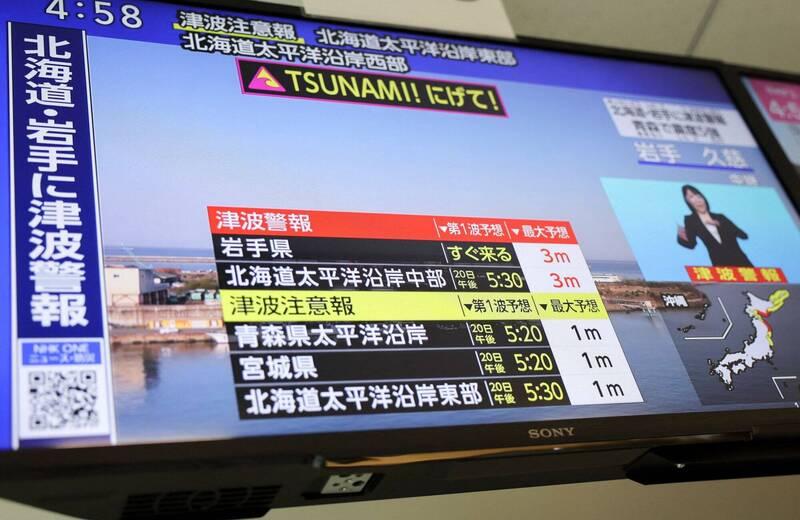
In response to the seismic event's potential, the JMA issued a tsunami warning specifically for waves up to three meters along the affected northern coasts.[2][3] This advisory was critical, as it urged evacuation from low-lying areas and prepared communities for possible larger inundations. The warning's scope covered northeastern Japan, aligning with the quake's epicenter near Iwate, where wave heights could pose significant threats to harbors, roads, and residences.[3] The observed 80-centimetre wave at Kuji served as an early indicator that the tsunami warning was warranted, prompting ongoing monitoring by the JMA.[2] Such developments are standard protocol in Japan, a nation with one of the world's most advanced tsunami detection networks, including offshore buoys and coastal gauges that provide real-time data.[2]
The progression from the initial quake to measurable waves underscores the linked hazards of megathrust earthquakes in subduction zones. While the 80-centimetre height was not catastrophic on its own, it validated the three-meter warning threshold, ensuring preparedness for any escalation.[2][3] JMA updates continued to track subsequent waves, emphasizing the fluid nature of tsunami events where multiple surges can follow the first.[2]
Impact on Affected Areas
The earthquake's effects rippled across multiple regions, with the strongest sensations reported near Iwate prefecture where the offshore epicenter was located.[5] This area, off the northern Japan coast, bore the brunt of the initial shaking, as the magnitude 7.4 event displaced coastal communities.[5] Large buildings as far away as Tokyo experienced noticeable tremors, illustrating the quake's extensive reach and the interconnected seismic sensitivity of Japan's urban centers.[5]
Iwate, a prefecture with rugged coastlines and fishing ports like Kuji, faced dual threats from ground motion and sea surges. The shaking was sufficient to unsettle structures hundreds of kilometers away, raising concerns about structural integrity in older buildings and infrastructure.[5] Tokyo's high-rises swaying served as a stark reminder of how even distant quakes can disrupt daily life in the capital, potentially causing minor disruptions like halted trains or evacuations.[5] No immediate reports of casualties or major damage were detailed, but the scale suggested inspections would be necessary for bridges, ports, and nuclear facilities in the region—standard procedure following such events.[5]
Coastal areas in northern Japan, particularly around the epicenter, saw the tsunami's direct touch, with the 80-centimetre wave at Kuji potentially flooding port facilities and low areas.[2][5] This combination of shaking and waves amplifies risks to evacuation routes and emergency services, as seen in past events. The broad impact from Iwate to Tokyo highlighted the national scope, with authorities likely mobilizing resources for assessments.[5]
Timeline of Events
The sequence began at 4:53 pm when the magnitude 7.4 earthquake struck off northern Japan, as recorded by the JMA.[2] This initial rupture set off the chain of events, with seismic waves propagating rapidly outward.[2]
By 5:32 pm, the first tsunami precursor—a 70-centimetre wave—reached the port in Kuji, Iwate, signaling the arrival of displaced seawater.[2] Just two minutes later, at 5:34 pm (1:34 pm PKT), the more significant 80-centimetre wave followed, confirming active tsunami generation.[2] Concurrently, the JMA escalated its response by issuing a tsunami warning for up to three metres, disseminated almost immediately after the quake to maximize lead time.[2]
This tight timeline—from 4:53 pm quake to waves within 40 minutes—exemplifies the urgency in Japan's hazard response system, where minutes count for evacuations.[2] The JMA's precise timings underscore their monitoring precision, allowing for layered alerts as data evolved from 70 cm to 80 cm observations.[2]
Official Responses
Japan's Meteorological Agency (JMA) took immediate action, issuing a tsunami warning for waves up to three meters following the 4:53 pm magnitude 7.4 quake.[2][3] This directive targeted northeastern coastal areas, instructing residents to seek higher ground.[2][3]
The JMA also provided detailed wave confirmations, reporting the 80-centimetre surge at Kuji port at 5:34 pm and the prior 70-centimetre wave at 5:32 pm, which informed ongoing advisories.[2] Such responses reflect Japan's drilled protocols, with the agency coordinating with local governments for evacuations and monitoring.[2][3]
Authorities in affected prefectures like Iwate likely activated emergency centers, given the quake's reach to Tokyo.[5] The JMA's role as the central hub ensured unified messaging amid the rapid developments.[2][3]
What to watch next: Monitor JMA updates for any further tsunami waves or aftershocks, as the agency continues tracking activity following the initial 80-centimetre surges and three-meter warning.[2][3]