
China Severe Weather Forces Evacuation of Over 900,000 Ahead of Typhoon Bavi Landfall
Chinese authorities evacuated more than 900,000 people amid China severe weather conditions ahead of Typhoon Bavi's expected landfall near Wenzhou on Sunday, as the country continued to grapple with the deadly aftermath of Typhoon Maysak. [1]
Evacuations and Preparations for Typhoon Bavi
Chinese authorities evacuated more than 900,000 people ahead of Typhoon Bavi's expected landfall on Sunday. [1] More than 600,000 people were evacuated from their homes in eastern Zhejiang province and another 100,000 in neighbouring Fujian province. [2] In Beijing, authorities evacuated more than 100,000 people after increasing water discharge from the Miyun Reservoir to create additional capacity for expected floodwaters. [1] The Wenzhou city government told news agency AFP that 887,801 people had been evacuated by late Friday. [1] Wenzhou authorities stated that the proactive, all-out mobilisation, which is sparing no effort or cost, is undertaken entirely to guard against the worst-case scenario. [1] State broadcaster CCTV showed residents using wooden planks to reinforce metal shutters on shops and taping windows as officials warned of exceptionally heavy rains across eastern Zhejiang and neighbouring Fujian province. [1] In Ningde city, Fujian province, more than 3,700 people were evacuated from high-risk onshore areas by Friday evening, while authorities placed more than 17,000 emergency rescue workers on standby. [2] Wenzhou resident Huang Xinghuan, 50, told Reuters news agency while buying groceries at a traditional wet market before it closed ahead of the typhoon that he was a little worried but thought it would be OK because his family had stocked about two or three days’ water and supplies remained guaranteed. [2] Chen Qiuqin, in her 60s, walked through steady rain on her way to her parents’ home to help them prepare and said she was not too concerned given the government’s preparations, noting she was worried about the flowerpots on her mother’s balcony. [4]
Bavi's Path, Intensity, and Immediate Impacts

Chinese authorities evacuate residents in Zhejiang province ahead of Typhoon Bavi landfall. — Source: aljazeera Typhoon Bavi is forecast to make landfall in Wenzhou, a densely populated city in Zhejiang, in the early hours of Sunday after lashing Taiwan and Japan's southwestern islands. [1] The Central Weather Administration said Bavi had weakened from a super typhoon to a typhoon after moving across the Pacific Ocean and reported maximum sustained winds of 137 kmph, with gusts reaching around 173 kmph, while warning of extremely torrential rain and coastal waves of up to 10 metres. [1] Although significantly weakened since it thundered through the US Pacific islands on Monday and tracked northwest, Typhoon Bavi remains a significant risk due to the large volumes of moisture it carries in its rain bands. [2] Bavi is expected to bring exceptionally heavy rains to eastern Zhejiang and Fujian. [1] Even as Bavi continues to slow and weaken on its northwesterly path over cooler seas, the typhoon is still a potent risk due to the sheer volume of moisture it holds within its rain bands, about the size of France from end to end. [4] The national weather agency issued an orange typhoon alert, the second-highest on a four-level rating. [2]
Aftermath of Typhoon Maysak in Southern and Central China
Typhoon Maysak may have weakened after making landfall in China's Hainan province on July 3, but its aftermath is still unfolding. [1] At least 39 people died in the city of Nanning, where a breached dam sent torrents of water through the streets. [2] In the southern city of Hengzhou, around 900 snakes, many of them venomous, escaped from a breeding facility on July 6 after floodwaters inundated the area, according to the Shanghai Daily. [1] China’s southern region of Hainan and Guangxi are still reeling from the effects of Tropical Storm Maysak earlier this week. [2] Storms have already left at least 39 people dead, caused dozens of rivers to overflow and triggered the collapse of a reservoir dam, according to Chinese authorities. [1]
Regional Effects in the Philippines, Taiwan, and Japan
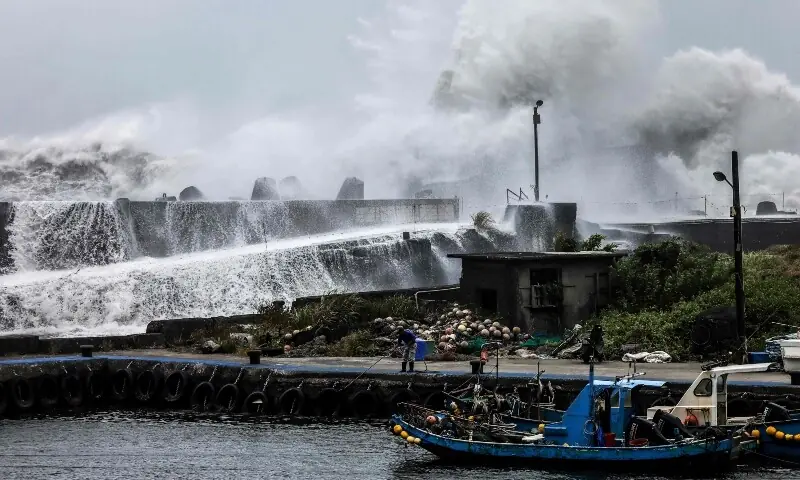
Chinese authorities evacuate over 900000 people ahead of Typhoon Bavis landfall in Wenzhou. — Source: dawn At least 17 people were killed in the Philippines after heavy rains brought on by an enhanced southwest monsoon and worsened by Bavi’s impact triggered landslides overnight on Friday. [2] In the Philippines, authorities said the death toll linked to heavy rain and landslides associated with the enhanced southwest monsoon, intensified by Bavi, had risen to 18, nearly 11,000 people were displaced and 313 vessels remained sheltered as dozens of ports stayed closed. [1] Taiwanese authorities evacuated 14,000 people, mainly from mountainous areas, while hundreds of flights were cancelled and more than 170,000 households lost electricity. [1] In Taiwan, at least 36 people have been injured, mainly while riding motorcycles on slippery roads in the heavy rain and winds, and 14,210 people were evacuated across the island by Saturday morning, particularly from the city of Taichung and the county of Hualien. [2] Although Bavi is not expected to make landfall on the island, the government said precautionary measures were necessary because forecasts indicated that some areas could receive nearly one metre of rainfall. [1] In Japan, the typhoon battered the country's remote southwestern islands, leaving more than 18,000 households and facilities without electricity, with the Miyako region experiencing the worst disruption. [1] Japanese airlines cancelled dozens of flights, affecting more than 26,000 passengers. [1] While Japan and Taiwan have not so far reported any deaths from the typhoon, 17 people died in the Philippines due to heavy rains brought by an enhanced southwest monsoon, worsened by Bavi’s impact. [4]
Broader Context of Extreme Weather
Scientists quoted by AFP have warned that warmer ocean temperatures are increasing the intensity of tropical cyclones. [1] The European Union's Copernicus Marine Service said last week that the world's oceans experienced their hottest June on record, while the return of El Nino this year is also expected to contribute to more extreme weather conditions across the Pacific. [1]
Disruptions to Travel and Daily Life
More than 130 flights between Hong Kong, Taiwan, mainland China and Japan have been cancelled, while 10 high-speed rail services have been suspended as Typhoon Bavi barrels towards China’s east coast. [3] Hong Kong International Airport’s webpage showed that 64 inbound flights and 71 outbound flights were cancelled on Saturday, with more than half scheduled to travel between the city and Taipei. [3] Services between Hong Kong and Kaohsiung, Shanghai and Hangzhou were cancelled, while a handful of flights to Osaka, Tokyo and Nagoya were also axed. [3] The MTR Corporation said 10 high-speed rail trips connecting Hong Kong with the mainland had been cancelled, including services between West Kowloon station and Shanghai, Fuzhou, and Guangzhou, and eight other high-speed rail trips scheduled for Sunday were also cancelled. [3] Hundreds of flights have been cancelled, rail travel services have been reduced, and many schools and ferry services have been suspended. [2] Almost all cities and counties across Taiwan declared a typhoon holiday for Saturday, closing any offices and schools that may have been open on the weekend. [4] The main north-south high-speed rail line also continued to operate, but with reduced service. [4] In Japan, more than 200 flights were cancelled across the country as authorities in the southern Okinawa prefecture warned of high waves, strong winds and storm surges. [2]
What to watch next: Bavi is forecast to make landfall around Wenzhou in the early hours of Sunday, with eastern Zhejiang and Fujian facing exceptionally heavy rains, while southern China continues recovery from Maysak’s flooding and dam breach.