
China Severe Weather Evacuates 1.7 Million as Typhoon Bavi Makes Landfall in Zhejiang
Typhoon Bavi made landfall in China’s eastern province of Zhejiang late on Saturday night with maximum sustained winds of 144 kph near its centre, prompting authorities to evacuate more than 1.7 million people as China severe weather conditions prompted high alerts for heavy rain and flooding. [1] [2] Bavi came ashore first in the coastal city of Yuhuan before a second landfall near Taizhou, with the storm expected to move northwestward inland while gradually weakening. [1] [3]
Landfall and Immediate Impacts in Zhejiang
Typhoon Bavi made landfall at around 11:20 pm Saturday in Zhejiang province in the coastal city of Yuhuan before making a second landfall in Wenzhou around midnight. [2] [3] The typhoon packed winds swirling at up to 144 kilometres per hour as it roared ashore. [2] Bavi is forecast to bring exceptionally heavy rains to eastern Zhejiang province and northeastern Fujian province. [1] [3] The city of Wenzhou, home to around 10 million people, lies close to the path of the storm. [3] Residents used wood to reinforce metal shutters protecting shops and taped windows ahead of the arrival. [2] Bavi had been downgraded from a super typhoon after slamming into Guam and the Northern Marianas on Monday with wind speeds of 290 km/h. [3]
Evacuations and Preparedness Measures
Authorities in Zhejiang had evacuated more than 1.7 million people by Saturday morning. [1] As of Saturday morning, authorities had evacuated 1.72 million people to safe places. [2] By noon, Shanghai relocated around 34,000 residents from high-risk areas. [1] In Ningde in Fujian province, more than 3,700 people were relocated from high-risk onshore areas as of Friday evening. [1] More than 130,000 people have fled their homes in Fujian. [2] In Beijing, more than 100,000 people were evacuated due to torrential rain after water discharge flows from the capital’s Miyun Reservoir were ramped up. [2] [5] Chinese authorities issued an orange typhoon alert, the second-highest on a four-tier level. [1] The centre on Saturday also issued the first red alert for rainstorms of the year. [1] Many schools and ferry services were suspended. [1] Hundreds of flights have been cancelled, and some high-speed railway services halted. [1] More than 400 flights and dozens of train services were cancelled in the province. [2] Authorities in Fujian province placed over 17,000 emergency rescue workers on standby. [1] Chinese authorities allocated 40 million yuan in central natural disaster relief funds to support Zhejiang and Fujian provinces’ typhoon prevention and emergency rescue and relief efforts. [1] The Wenzhou city government stated that 887,801 people had been evacuated by late Friday. [5] The proactive, all-out mobilisation, which is sparing no effort or cost, is undertaken entirely to guard against the worst-case scenario. [2] [3]

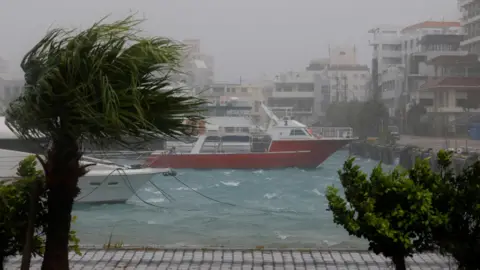
Typhoon Bavi makes landfall in Zhejiang province with strong winds prompting mass evacuations. — Source: vnexpress
Effects on Taiwan and Japan
Bavi brushed past northern Taiwan after passing north of the island on Saturday. [1] Taiwanese authorities registered at least 113 injuries from Typhoon Bavi, some sustained while riding motorcycles in rain and winds on slippery roads. [1] Taiwan’s fire department said 87 people had been injured, mostly from falls from motorcycles or bicycles as well as people falling over or being struck by objects. [4] More than 14,200 people had also been evacuated around the island, including from the eastern county of Hualien and the central city of Taichung. [1] More than 14,000 people have been evacuated from their homes. [2] Hundreds of flights were cancelled and more than 170,000 households across the island were hit with power outages. [2] 920 international flights were cancelled, effectively closing Taiwan’s main international airport at Taoyuan, as well as all 282 domestic flights. [4] Schools and offices in most parts of Taiwan were suspended Saturday. [1] Taiwan’s Central Weather Administration warned of extremely torrential rain across northern Taiwan and dangerous waves of up to 10 metres along the coast. [2] Across Japan’s southern islands in the prefecture of Okinawa, more than 200 flights were cancelled across the region. [1] Strong winds and rain had hit islands including Ishigaki. [1] Thousands of households and facilities across Okinawa lost power as the typhoon pounded Japan’s remote southwestern islands, with the Miyako region hardest hit. [2] Japanese airlines cancelled dozens of flights, affecting more than 26,000 passengers. [2] [5] More than 18,000 households and facilities across Okinawa lost electricity. [5]
Philippines Landslides and Fatalities
In the Philippines, monsoon rains intensified by Bavi triggered landslides that killed at least 17 people. [1] The death toll from landslides and other incidents triggered by heavy rains driven by Bavi rose to 18, most on the southern island of Mindanao. [2] A landslide set off by monsoon rains that Bavi intensified hit a village before dawn Friday in the coastal town of Malapatan in southern Sarangani province, killing at least 10 villagers and leaving three others missing. [1] A separate landslide in Calanogas town in southern Lanao del Sur province before dawn on Friday killed five people, with six others missing. [1] Two people drowned in floodwaters Wednesday in the southern province of Bukidnon. [1] About 11,000 villagers moved to 77 emergency shelters mostly in southern Philippine provinces in recent days due to the stormy weather. [1] Nearly 11,000 people across the archipelago fled their homes and dozens of ports remain closed, with 313 vessels taking shelter. [2] [5]

Rain clouds cover downtown Wenzhou as Typhoon Bavi approaches Zhejiang province in China. — Source: cyprusmail
Context from Preceding Typhoon Maysak
Bavi is the second typhoon to impact China in just over a week’s time after Maysak made landfall in southern China on July 3. [1] Extreme weather has already wreaked havoc on southern and central China this week, with storms leaving at least 39 dead and causing dozens of rivers to overflow and a reservoir dam to burst. [2] Maysak left at least 39 people dead and killed large numbers of livestock, resulting in massive agriculture loss. [3] It also spurred two rare tornadoes in the central Hubei province. [3] In the southern city of Hengzhou, around 900 snakes, many of them venomous, escaped from a breeding facility on July 6 after floodwaters inundated the area. [5]
Forecast and Broader Weather Context
Bavi, which spans roughly 1,000 km at its widest point, is expected to keep moving to the northwest while weakening. [2] [3] Bavi is forecast to make landfall around Wenzhou early on Sunday. [4] Though it has weakened to a Category 1 typhoon, it still presents a risk because of the huge volume of moisture within its rain bands. [3] Bavi had been on track on Friday to be the largest typhoon to hit Taiwan in more than 30 years, but its strong-wind radius has since shrunk to 350 kilometres. [2] Oceans experienced their hottest June on record and could set fresh highs in the months ahead. [2] Warmer oceans help tropical storms to intensify and add more moisture, which can fall as heavy rain. [2] Adding to the mix is the return this year of El Nino, a natural climate phenomenon that warms Pacific Ocean surface temperatures and typically occurs every two to seven years. [2] [5]
What to watch next: Bavi is expected to move northwestward inland while bringing exceptionally heavy rains to eastern Zhejiang and northeastern Fujian as it continues to weaken over cooler seas.




