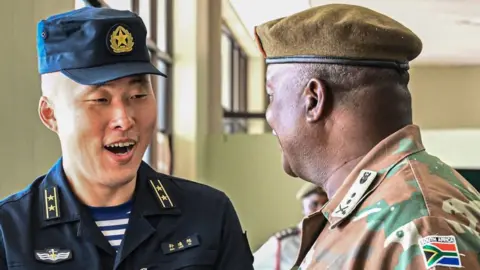

China Leads BRICS Naval Drills in South African Waters as Pretoria-US Tensions Simmer
Cape Town, South Africa – China is spearheading multinational naval exercises involving BRICS nations in South African waters, a move set to commence on January 3, 2026, that underscores deepening defense ties among the bloc's members while potentially exacerbating friction between Pretoria and Washington.
The joint drills, described as "war games" by observers, will feature naval forces from China, Russia, Iran, and South Africa, among other BRICS participants. This development marks a notable escalation in military cooperation within the BRICS framework, which has expanded in recent years to include new members like Iran, Egypt, Ethiopia, and the United Arab Emirates. The exercises are taking place off South Africa's coast, highlighting the country's strategic position along key Indian Ocean shipping routes.
According to reports, the initiative is led by the People's Liberation Army Navy (PLAN), signaling Beijing's growing influence in Southern Africa and the broader Global South. South Africa's Department of Defence has confirmed participation, framing the drills as routine multinational training to enhance interoperability and maritime security. However, the involvement of Iran and Russia—nations under Western sanctions—has drawn scrutiny, particularly from the United States, where concerns over countering Western alliances are mounting.
Strained Pretoria-Washington Relations
The timing of the exercises comes amid already tense relations between South Africa and the US. Pretoria has faced criticism from Washington over its foreign policy stances, including its decision to institute genocide proceedings against Israel at the International Court of Justice (ICJ) in late 2023 over operations in Gaza—a case that remains ongoing. Additionally, South Africa's hosting of Hamas and Iranian officials has irked US policymakers.
These frictions are set to intensify under a potential return of Donald Trump to the White House, following his projected inauguration in January 2025 after the 2024 US presidential election. Trump has publicly clashed with South African President Cyril Ramaphosa's administration, accusing it of anti-Western leanings and land expropriation policies targeting white farmers—claims Pretoria has repeatedly denied as misrepresented. BBC reporting notes that the naval drills "could inflame relations with Donald Trump - who is already at loggerheads with Pretoria," potentially leading to diplomatic repercussions or sanctions threats.
US officials have not yet issued a formal response to the drills, but analysts point to Washington's broader strategy of countering BRICS expansion through initiatives like the Quadrilateral Security Dialogue (Quad) and AUKUS pact in the Indo-Pacific. The exercises evoke memories of previous BRICS naval engagements, such as the 2023 Mavi Balina drills hosted by South Africa, which involved Russia, China, and India but did not include Iran.
BRICS Defense Cooperation in Context
BRICS, originally comprising Brazil, Russia, India, China, and South Africa since 2009, has evolved into a counterweight to institutions like the G7 and NATO. The group's 2024 expansion at the Johannesburg summit added six new members, boosting its economic heft to represent over 45% of the global population and 35% of world GDP (PPP terms). Military collaboration has accelerated, with joint exercises serving to promote de-dollarization efforts, alternative payment systems like the BRICS Pay, and shared security interests.
China's leadership role in these drills aligns with its Maritime Silk Road ambitions under the Belt and Road Initiative (BRI), through which Beijing has invested heavily in South African ports like Durban and Cape Town. Russia, meanwhile, has deepened ties with Pretoria via arms sales and nuclear energy deals, while Iran's inclusion reflects its full BRICS membership since January 2024, aimed at evading sanctions through bloc solidarity.
South African military experts emphasize the drills' focus on non-combat scenarios, including anti-piracy operations, search-and-rescue, and counter-terrorism tactics—critical for a region plagued by maritime threats in the Mozambique Channel and Gulf of Guinea. The South African Navy's participation involves assets like the Valour-class frigates, with the exercises expected to last several days.
Historical Background on South Africa's Geopolitical Balancing Act
South Africa's post-apartheid foreign policy has emphasized non-alignment, multilateralism, and South-South cooperation, as enshrined in its Constitution and National Development Plan. This approach has led to partnerships across ideological lines: hosting US Africa Command (AFRICOM) engagements while maintaining strong BRICS links.
Ties with the West remain economically vital— the US is South Africa's second-largest trading partner after China—but political divergences have grown. The African Growth and Opportunity Act (AGOA), granting duty-free US market access, faces renewal debates in Congress, with some lawmakers citing Pretoria's Russia-Ukraine neutrality and ICJ case as grounds for exclusion.
Previous BRICS summits in South Africa, notably 2018 in Johannesburg and 2023 virtually, have prioritized infrastructure and trade, but defense has gained prominence post-Ukraine invasion in 2022, when Pretoria abstained from UN votes condemning Moscow.
Outlook for Regional Stability
As the drills unfold, eyes will be on any US diplomatic maneuvers, such as statements from the State Department or Trump's incoming administration. For South Africa, balancing BRICS engagement with Western partnerships is key to sustaining its role as Africa's most industrialized economy and G20 member.
The exercises could bolster BRICS cohesion ahead of its 2026 summit in Kazan, Russia, but risk alienating investors wary of geopolitical volatility. With global shipping lanes at stake, the South African waters drills serve as a litmus test for multipolar dynamics in the Indian Ocean, where competition between Beijing, Washington, and New Delhi intensifies.
(Word count: 712)






