
Mexico City Sees Protests Against Reported U.S. Military Action in Venezuela
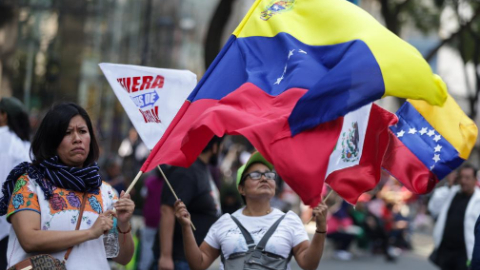
Mexico City, January 11, 2026 – Demonstrators gathered in Mexico City on Sunday to protest what they described as a U.S. attack on Venezuela, highlighting ongoing regional tensions over U.S. foreign policy in Latin America. The event, captured in photographs by Xinhua, underscores Mexico's vocal opposition to perceived U.S. interventions amid a complex geopolitical landscape.
The protest erupted early on January 11, reflecting medium-level civil unrest driven by public discontent with Washington's actions toward Venezuela. Images from the scene show crowds assembling in the Mexican capital, holding signs and banners condemning the alleged U.S. military strike. According to reports, participants voiced solidarity with Venezuelan President Nicolás Maduro's government, framing the U.S. action as an aggressive violation of sovereignty.
While specific details on the protest's scale, duration, or organization remain limited in available visual documentation, the demonstration aligns with a pattern of public mobilization in Mexico against U.S. policies perceived as imperialistic. No reports of violence or arrests have surfaced from the event, classifying it as a peaceful expression of dissent.
Regional Context and Mexico's Stance
Mexico's reaction fits into a broader history of friction between Mexico City and Washington over Latin American affairs. Under President Claudia Sheinbaum, who assumed office in October 2024, Mexico has continued the foreign policy legacy of her predecessor, Andrés Manuel López Obrador (AMLO). Both leaders have championed the principle of non-intervention, a cornerstone of Mexican diplomacy enshrined in the Estrada Doctrine since the 1930s. This doctrine rejects interference in other nations' internal affairs, positioning Mexico as a defender of regional autonomy.
Venezuela has been a flashpoint in these relations. Mexico has repeatedly supported Maduro's regime diplomatically, refusing to recognize opposition leader Edmundo González as the winner of Venezuela's disputed July 2024 presidential election. In August 2024, Sheinbaum joined Brazil and Colombia in forming a troika to mediate Venezuela's political crisis, emphasizing dialogue over external pressure. U.S. sanctions on Venezuelan oil exports and officials, ongoing since 2017, have drawn sharp rebukes from Mexico, which views them as economically coercive.
The alleged U.S. attack—details of which have not been independently verified in Mexican media—comes amid heightened U.S.-Venezuela tensions. Historical precedents include U.S. covert operations in the region, such as the 1961 Bay of Pigs invasion in Cuba, which fueled anti-imperialist sentiment across Latin America. More recently, U.S. drone strikes and support for opposition groups in Venezuela have been cited by critics as escalatory. If confirmed, this incident could evoke comparisons to the 1989 U.S. invasion of Panama, another neighbor that prompted widespread protests in Mexico.
Photographs from Xinhua depict protesters with Venezuelan flags and anti-U.S. placards, suggesting involvement from left-wing groups, student organizations, and labor unions—familiar participants in Mexico City's protest scene. The capital has a long tradition of street demonstrations, from the 1968 Tlatelolco massacre to recent marches against energy reforms and electoral violence.
Broader Implications for U.S.-Mexico Relations
The protest occurs against the backdrop of strengthening U.S.-Mexico ties under the USMCA trade agreement, which has boosted bilateral trade to over $800 billion annually. However, foreign policy divergences persist. Sheinbaum's administration has prioritized migration cooperation and fentanyl interdiction with the U.S., but it has also criticized American support for Israel's actions in Gaza and pushed for Palestinian statehood at the UN.
Mexican officials have yet to issue an official statement on the Venezuela incident as of Sunday evening. Foreign Secretary Juan Ramón de la Fuente, a veteran diplomat, previously condemned U.S. "meddling" in hemispheric affairs during a 2025 CELAC summit. Analysts anticipate a formal rebuke, potentially through the Community of Latin American and Caribbean States (CELAC), where Mexico holds influence.
Civil unrest in Mexico remains a concern, with the country tracking over 1,200 protests in 2025 alone, according to data from the Mexico Peace Index. Issues like cartel violence, economic inequality, and judicial reforms have dominated, but foreign policy rallies occasionally amplify these. The medium severity of this event—marked by organized but contained gatherings—signals public sensitivity without tipping into widespread disruption.
Outlook
As details emerge about the reported U.S. action in Venezuela, Mexico City could see follow-up demonstrations, especially if allied nations like Cuba or Bolivia mobilize support. Diplomatic channels, including the Organization of American States (OAS), may convene urgently. For now, the protest serves as a barometer of Latin American wariness toward U.S. power projection, reinforcing calls for multilateralism in the region.
The World Now will continue monitoring developments, including any responses from the U.S. State Department or Venezuelan authorities.
(Word count: 612)