
Mexico City Protest Erupts Against Reported U.S. Military Action in Venezuela
Mexico City, January 11, 2026 — Hundreds of demonstrators gathered in the heart of Mexico City on Sunday to protest what they described as a U.S. attack on Venezuela, highlighting growing public discontent with American foreign policy in Latin America. The medium-severity civil unrest event, which began around 6:38 a.m. GMT, underscores longstanding regional sensitivities over U.S. interventions in the hemisphere.
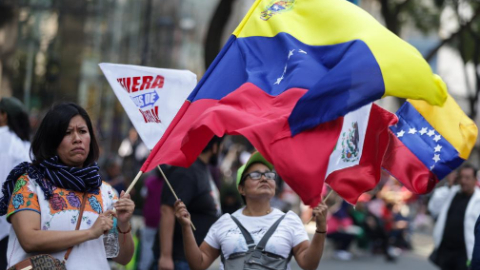
Visual reports from the scene captured protesters marching through key streets, carrying signs and banners denouncing the alleged U.S. military action. Organized under the banner of solidarity with Venezuela, the demonstration reflected broader public unrest amid escalating tensions between Washington and Caracas. According to coverage from Xinhua, the protest featured vivid imagery of crowds assembled in the Mexican capital, waving Venezuelan flags alongside Mexican ones, and chanting slogans against perceived imperialism.
Details of the Demonstration
The protest unfolded peacefully but with visible intensity, as participants condemned the reported U.S. strike on Venezuelan territory. Xinhua's photographic documentation showed demonstrators holding placards reading messages in Spanish such as "No to Yankee aggression" and "Hands off Venezuela," though specific quotes from organizers were not detailed in initial reports. The event's timing, just hours after its reported start, suggests it was a rapid mobilization in response to breaking news of the U.S. action.
No arrests or clashes with authorities were reported in the available coverage, aligning with the event's classification as medium severity. Mexican police maintained a presence to ensure order, consistent with standard protocols for public gatherings in the capital. The demonstration appears to have been coordinated by left-leaning civil society groups, labor unions, and pro-Venezuela activists, though exact attendance figures remain unconfirmed.
Historical Context of U.S.-Venezuela Tensions
The protest occurs against a backdrop of decades-long friction between the United States and Venezuela. Since the early 2000s, under presidents Hugo Chávez and later Nicolás Maduro, Venezuela has positioned itself as a counterweight to U.S. influence in Latin America, fostering alliances through organizations like the Bolivarian Alliance for the Peoples of Our America (ALBA). The U.S. has imposed extensive sanctions on Venezuelan officials and entities since 2017, citing human rights abuses, corruption, and electoral irregularities, measures that Caracas and its allies view as economic warfare.
Mexico, under President Claudia Sheinbaum—who assumed office in October 2024 following the tenure of Andrés Manuel López Obrador—has maintained a policy of non-intervention and solidarity with Venezuela. Both López Obrador and Sheinbaum have criticized U.S. sanctions and supported dialogue in the Venezuelan crisis. In 2023, Mexico hosted talks between Maduro's government and opposition factions as part of the Mexico Group initiative alongside Brazil and Colombia. This stance resonates with segments of Mexican society that recall U.S.-backed interventions in the region, such as the 1965 Dominican Republic occupation or support for coups in the 20th century.
Recent escalations have further fueled such sentiments. Venezuela's disputed 2024 presidential election, where Maduro claimed victory amid fraud allegations, prompted renewed U.S. sanctions and international isolation efforts. Reports of military posturing along the Venezuela-Guyana border over the Essequibo region have added to hemispheric volatility. Any confirmed U.S. military action would mark a dramatic shift, potentially invoking the Monroe Doctrine's legacy while risking backlash from Latin American nations wary of extraterritorial strikes.
Mexico's Domestic Political Landscape
In Mexico, protests against U.S. foreign policy are not uncommon. Large-scale demonstrations occurred in 2003 against the Iraq War and in 2019 over U.S. threats of tariffs and intervention in Mexico's immigration policies. The current event taps into similar veins, amplified by Mexico's progressive Morena party dominance and public fatigue with perceived northern hegemony. Social media footage circulating online echoed Xinhua's images, showing families, students, and workers uniting in condemnation, though platforms like X (formerly Twitter) also hosted counter-narratives questioning the U.S. action's details.
President Sheinbaum's administration has yet to issue an official statement on the protest or the Venezuela incident as of publication, but Foreign Relations Secretary Alicia Bárcena has historically advocated for multilateral solutions to regional conflicts. Mexico's constitution emphasizes sovereignty and peaceful coexistence, principles likely to frame any governmental response.
Broader Regional Implications
This Mexico City rally is part of a pattern of civil unrest across Latin America reacting to U.S.-Venezuela dynamics. Similar demonstrations have been noted in Brasília, Buenos Aires, and Havana in recent months, signaling a unified front among leftist governments. Brazil's President Luiz Inácio Lula da Silva and Colombia's Gustavo Petro have voiced support for Venezuela's territorial integrity, potentially complicating U.S. diplomatic efforts.
As investigations into the reported U.S. attack continue—details of which remain sparse in public domains—the protest serves as a barometer of public mood. Analysts note that such events could influence upcoming regional summits, including the Community of Latin American and Caribbean States (CELAC) meetings, where non-intervention is a core tenet.
The demonstration's fallout remains to be seen, but it reaffirms Mexico's role as a vocal advocate for Latin American autonomy. With global attention fixed on the Venezuela crisis, further protests or escalations could reshape hemispheric relations in 2026.
(Word count: 712)